

A vehicle sitting in a Michigan driveway after a family member passes away isn’t just an eyesore. It’s a legal liability that complicates the probate process. You’re likely wondering what to do with a deceased relative’s car while dealing with grief and administrative paperwork. It’s frustrating to manage lost titles, missing keys, or a vehicle that won’t start. You want the estate settled and the driveway cleared. You need a solution that doesn’t involve endless court dates or expensive repairs.
You can handle this transaction quickly without the typical Michigan Secretary of State headaches. This guide explains how to use the 2026 TR-40 forms to bypass probate when the vehicle estate value is under the $100,000 threshold. We’ll show you the exact legal steps to transfer ownership even if you can’t find the original title. You’ll discover how to turn that unwanted asset into immediate cash for the estate. We cover everything from SOS fees to free vehicle removal. You can settle the estate and get paid today.
Key Takeaways
- Understand heir priority rules in Michigan to ensure the correct family member signs the transfer documentation.
- Identify the specific documentation required by the Michigan Secretary of State to finalize a title transfer for an estate vehicle.
- Find out exactly what to do with a deceased relative’s car to avoid Secretary of State late fees and recurring storage costs.
- Compare the speed of a direct cash sale against the risks and delays of listing a non-running estate vehicle on private marketplaces.
- Secure immediate liquidity for the estate with free towing and on-the-spot payment, even if the title or keys are missing.
Understanding Michigan Probate and Vehicle Ownership
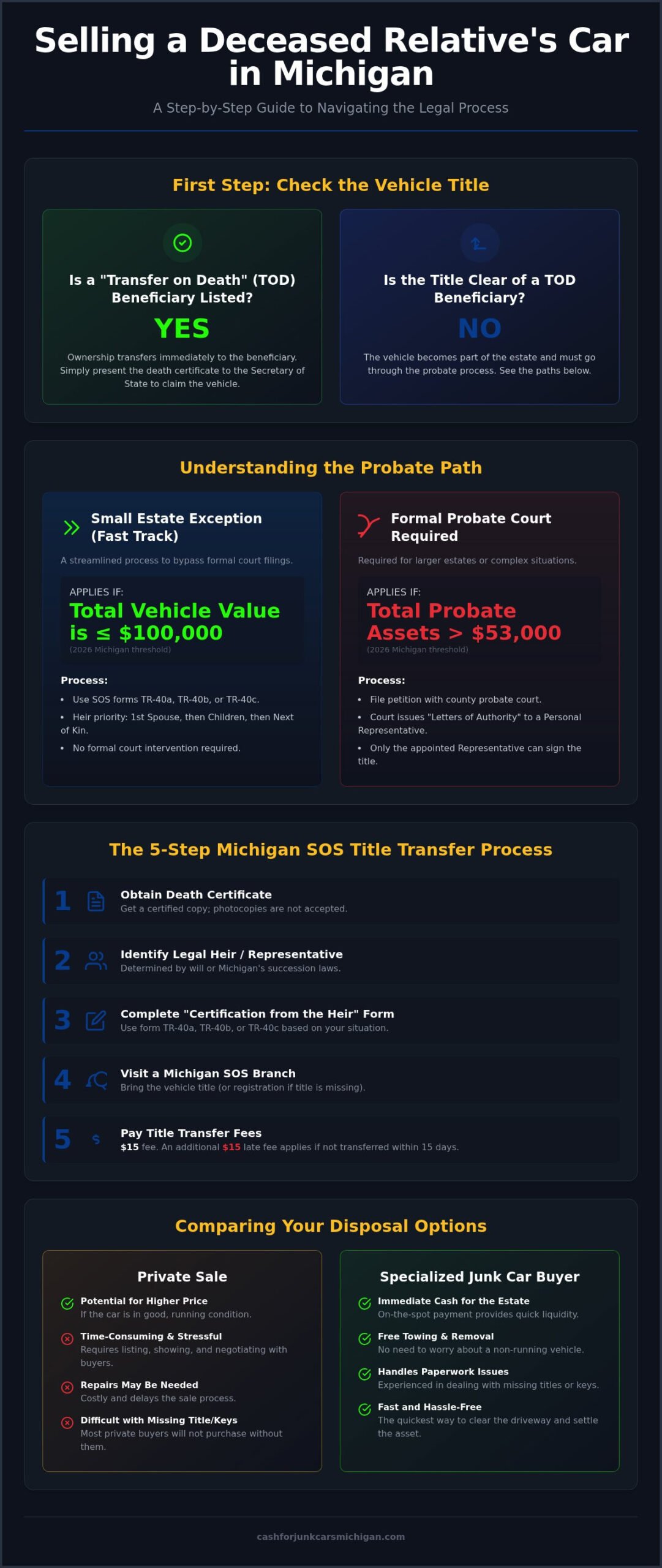
When a vehicle owner passes away in Michigan, the car doesn’t automatically belong to the family. It’s an asset that must be legally accounted for. The first step in deciding what to do with a deceased relative’s car is checking the title for a “Transfer on Death” (TOD) beneficiary. If the owner listed a beneficiary, that person takes ownership immediately after presenting a death certificate to the Secretary of State. If no beneficiary exists, the vehicle enters the probate process. This legal procedure determines who has the right to sell or keep the asset.
Michigan’s Small Estate Exception for Vehicles
You don’t always need a lawyer or a court date to move a car. Michigan provides a specific shortcut for estates under certain value limits. For 2026, you can transfer a vehicle without formal probate if the total value of all vehicles in the estate is $100,000 or less. You’ll use Michigan Secretary of State forms TR-40a, TR-40b, or TR-40c to complete this transfer. The surviving spouse has the first legal right to the vehicle. If there’s no spouse, the next of kin follows a specific order of priority starting with children. The “Certificate of Heir” process is a legal declaration where heirs confirm their right to the property to bypass formal court filings and expensive legal fees.
When Probate Court Intervention is Required
Larger estates or complex wills require formal probate court intervention. If the total probate assets exceed $53,000 in 2026, the court must oversee the distribution of property. You’ll need to file a petition with the county probate court where the relative lived. The court then issues “Letters of Authority” to an appointed Personal Representative. This individual is the only person legally allowed to sign the title over to a buyer or a junk car removal service. Don’t let the car sit while waiting for court dates. Vehicles lose value every day they remain idle. Fluids leak. Batteries die. Pests can move into the engine bay. Getting your legal authority quickly is the only way to secure the best price for the estate before the vehicle’s condition worsens.
Acting fast is critical. Michigan charges a $15 fee for title transfers, but missing the 15-day window for a sale can result in an additional $15 late fee. Knowing what to do with a deceased relative’s car early saves the estate money and prevents the vehicle from becoming a permanent fixture in the driveway.
How to Transfer a Vehicle Title After Death in Michigan
Clearing the legal title is the most critical step when deciding what to do with a deceased relative’s car. You cannot sell or donate the vehicle until the Michigan Secretary of State (SOS) recognizes you as the legal owner or authorized seller. If the vehicle has an outstanding lien, the process stops until the debt is satisfied. You must contact the lender to obtain a lien release. Without this document, the SOS will not issue a new title. Once the lien is clear, you can proceed with the standard transfer process.
The 5-Step Michigan SOS Transfer Process
Following a specific order prevents multiple trips to the SOS office. Follow these steps to finalize the paperwork:
- Step 1: Obtain a certified copy of the death certificate. Photocopies are generally not accepted for title transfers.
- Step 2: Identify the legal heir or personal representative. This is determined by the will or Michigan’s laws of intestate succession.
- Step 3: Complete the “Certification from the Heir to a Vehicle” form. Use forms TR-40a, TR-40b, or TR-40c depending on your specific situation.
- Step 4: Visit a Michigan SOS branch. Bring the current vehicle title or the most recent registration if the title is missing.
- Step 5: Pay the $15 title transfer fee. If you fail to transfer the title within 15 days of the sale or estate settlement, the SOS charges an additional $15 late fee.
You should review the official Michigan Secretary of State guidelines to confirm which TR-40 form fits your family structure. These rules ensure the vehicle moves to the correct person without full probate intervention.
Handling a Car With No Title or Keys
Estate cleanouts often reveal that the original car title was lost, destroyed, or filed away in an unknown location. If you are the legal heir, you can apply for a duplicate title, but this requires an extra fee and more time. Dealing with a vehicle that also lacks keys makes the situation even more difficult. Most private buyers won’t touch a car without a title and keys. It becomes a permanent fixture in the driveway, taking up valuable space while you wait for replacement paperwork from Lansing.
We solve this specific problem for Michigan families. If you have proof of your relationship to the deceased or court-ordered authority, you can get cash for junk cars even if the title is missing. We handle the logistical hurdles and provide free towing. This allows you to settle the vehicle estate immediately instead of waiting weeks for the SOS to mail a replacement title. You get paid on the spot and the car is removed the same day.
Evaluating the Car’s Role in the Estate: Asset or Liability?
Deciding what to do with a deceased relative’s car requires a cold look at the numbers. You must determine if the vehicle is a financial gain for the heirs or a drain on the estate’s remaining funds. In Michigan, an idle car quickly becomes a liability. Every week it sits in a driveway or garage, it loses value while accumulating costs. You need to act before the car’s maintenance and storage fees outweigh its actual worth.
Calculating the Real Value of an Estate Car
Market values for used vehicles in 2026 have stabilized, but older models or those with high mileage drop in price rapidly. Start by checking local scrap car prices to establish a baseline. If the vehicle requires significant repairs to pass a safety inspection, those costs must be subtracted from the potential sale price. Salvage value is the estimated worth of a vehicle’s individual parts and metal when the cost of repairs exceeds the car’s total market value. For many non-running vehicles, the salvage value is the most realistic figure you will see.
The “hassle tax” is another factor often overlooked during probate. Selling a car privately involves cleaning the interior, taking photos, listing it online, and meeting with multiple strangers. This takes time that grieving families often don’t have. While the vehicle title transfer process handles the legal ownership, the physical sale can drag on for months. If the car isn’t in top condition, the time spent managing a private sale often costs more than the profit it generates.
The Dangers of a ‘Zombie’ Vehicle
Parking a vehicle on Michigan streets or in an apartment complex can lead to immediate trouble. Local ordinances often allow for the towing and impoundment of vehicles with expired registrations or those that appear abandoned. These impound fees can reach hundreds of dollars in just a few days. Insurance premiums also remain a factor. Most insurers require a policy to stay active as long as the vehicle is registered, creating a recurring bill for the estate. These hidden costs turn a potential asset into a “zombie” vehicle that eats through the estate’s cash reserves.
Mechanical degradation is the silent killer of vehicle value. When you are stuck figuring out what to do with a deceased relative’s car, time is your enemy. Batteries fail within weeks of sitting. Tires develop flat spots. Brake rotors rust, and fuel begins to break down in the tank. We often see that junk cars lose a significant percentage of their part value the longer they are exposed to Michigan’s humidity and temperature swings. Selling the car for cash immediately stops this financial bleed and provides the estate with instant liquidity.
Comparing Your Disposal Options: Private Sale vs. Junking
Once you’ve cleared the legal hurdles, you must choose a disposal method. Listing a vehicle on Facebook Marketplace or Craigslist might seem like the way to get the highest price. However, these platforms require constant management. You’ll deal with low-ball offers and “is this still available” messages from people who never show up. When deciding what to do with a deceased relative’s car, consider your mental bandwidth. Grieving families often find the back-and-forth of private sales exhausting. You have to meet strangers at the relative’s home or a public lot. This adds unnecessary stress to an already difficult time.
The Private Sale Headache
Test drives and mechanical inspections are standard for private buyers. If the car has been sitting, it likely won’t pass a rigorous inspection without expensive repairs. Some executors consider selling car for parts to squeeze out more money. This is usually a mistake for a busy estate representative. Dismantling a vehicle requires tools, mechanical knowledge, and months of waiting for buyers. It leaves a shell of a car on the property that still needs professional removal. You’ll spend more on labor and storage than you’ll make back in component sales.
Donation is another option, but 2026 Michigan tax rules mean you only get a deduction if the charity sells the car or uses it. You won’t see immediate cash. For estates that need to cover funeral costs or outstanding debts, waiting for a tax break next year isn’t helpful. Private sales also come with liability risks if the buyer doesn’t transfer the title correctly. You could remain responsible for future tickets or towing fees. You need a solution that provides immediate liquidity and total closure.
The Junk Car Solution
Professional car buying services offer the fastest path to closure. You get an instant quote and same-day removal without cleaning the car or fixing the engine. You can sell my junk car in minutes instead of weeks. This eliminates the “stranger danger” of Marketplace and ensures the estate receives payment immediately. We buy vehicles in any condition across Michigan. We come to you, handle the loading, and pay on the spot. This allows you to clear the property and move on with the probate process without any lingering assets.
If you want the fastest way to settle the vehicle estate, contact us for an immediate cash offer. We handle the paperwork and the towing so you don’t have to.
The Fast Track: Selling an Estate Car to Cash For Junk Cars Michigan
Deciding what to do with a deceased relative’s car shouldn’t be a months-long project. You need to settle the estate and clear the property today. We provide a specialized “No-Hassle Estate Exit” for Michigan families. Our team understands that estate vehicles often come with missing paperwork, dead batteries, or lost keys. We don’t let these common issues stop the sale. We focus on speed and efficiency so you can focus on your family. We buy vehicles in any condition and provide the immediate liquidity needed to cover funeral costs or estate taxes.
Why Michigan Families Trust Us During Probate
We have years of experience handling vehicles that lack standard documentation. If you have the legal right to the estate, we can often buy the car without a physical title or registration. This removes the wait time for the Michigan Secretary of State to mail replacements. We offer same-day service across the entire state. Whether the car is in a cramped Detroit garage or a rural driveway, we come to you. Our pricing is completely transparent. The quote we give is the amount you receive. We never charge for towing or removal services. You get a clean transaction with no hidden deductions.
Our process is designed to be the business equivalent of a dependable problem-solver. We handle the logistical heavy lifting. You don’t need to worry about winching a non-running car out of the mud or finding a local tow truck. We bring the equipment and the cash. This immediate removal prevents city fines and stops the vehicle from losing more value to the elements. It’s the fastest way to turn a problematic asset into usable funds for the estate.
How to Get Started Today
Settling the vehicle portion of an estate takes just a few minutes with our team. Follow these simple steps to get paid:
- Call or text us: Provide the year, make, and model of the vehicle for an instant quote.
- Schedule your pickup: We work around the family’s schedule and offer same-day pickup in most Michigan locations.
- Verify authority: Show us your ID and estate documentation, such as the Letters of Authority or the TR-40 forms.
- Get paid: Receive cash on the spot. We provide a professional receipt for your estate records and probate court filings.
Don’t let an unwanted vehicle drain the estate’s resources. Take action now to clear the driveway and secure the funds the family needs. Ready to clear the estate? Get your instant cash quote from Cash For Junk Cars Michigan today!
Settle the Vehicle Estate Immediately
Deciding what to do with a deceased relative’s car shouldn’t be a source of ongoing stress. You’ve learned how to use Michigan’s TR-40 forms to bypass probate and handle title transfers efficiently. You also know that letting a vehicle sit only leads to mechanical failure, city fines, and lost value. Acting quickly is the best way to protect the estate’s assets and provide immediate liquidity for funeral or legal expenses. Every day the car remains in the driveway, it becomes a bigger liability for the family.
We provide a no-nonsense solution for families across the entire state. If you’re dealing with a lost title or missing keys, we handle those administrative hurdles for you. We provide same-day pickup and pay cash on the spot with free towing included from any Michigan location. There are no hidden fees or complex inspections to worry about. Get an Instant Cash Offer for Your Relative’s Car today. You can clear the property, settle the paperwork, and move forward with confidence.
Frequently Asked Questions
Can I sell my deceased relative’s car if I can’t find the title?
Yes, you can sell the car even if the original title is missing. Michigan law allows heirs to transfer ownership using specific Secretary of State forms like the TR-40 series. We specialize in buying estate vehicles without titles or registration. You only need to provide proof of your relationship to the deceased or court-issued Letters of Authority. This removes the delay of waiting for a duplicate title from the state.
How do I transfer a car title after a death in Michigan without probate?
You can use the small estate shortcut if the total value of all vehicles in the estate is $100,000 or less. The surviving spouse or next of kin must complete Michigan SOS Form TR-40. Bring this form and a certified death certificate to a Secretary of State branch. This process allows you to determine what to do with a deceased relative’s car without opening a full probate court case.
Who is legally allowed to sell a car after the owner dies in Michigan?
The surviving spouse has the first legal right to the vehicle in Michigan. If there is no spouse, the next of kin follows the order of intestate succession, starting with children. If the estate is in formal probate, only the court-appointed Personal Representative can sign the title. This individual holds the Letters of Authority required to finalize a legal sale to a private buyer or a professional junk car service.
What happens if the deceased relative still owed money on the car loan?
The estate must satisfy the outstanding lien before the title can be transferred or sold. Contact the lender immediately to obtain a payoff amount. Once the loan is paid, the lender issues a lien release. You cannot legally sell the car to a third party until the Secretary of State has a record that the lien is clear. This debt is usually paid directly from the estate’s remaining cash assets.
Do I need to insure the car while it’s sitting in the driveway during probate?
Yes, you should maintain insurance coverage as long as the vehicle is registered and parked in Michigan. State law requires valid insurance for all registered vehicles. If coverage lapses, the estate could face legal liabilities or expensive fines. Selling the car quickly for cash is the best way to stop these recurring insurance premiums. It protects the estate from unnecessary monthly expenses while the car sits idle.
Can I junk a car that belongs to an estate if it doesn’t run?
You can junk a non-running estate vehicle immediately to clear space and gain liquidity. We buy cars in any condition, including those with engine failure or body damage. We provide free towing anywhere in Michigan and pay cash on the spot. This is the fastest way to handle what to do with a deceased relative’s car when the vehicle is no longer a functional asset and is taking up space.
How long do I have to transfer the title after a relative passes away?
You should transfer the title within 15 days of a sale to avoid a $15 late fee from the Michigan Secretary of State. While the registration remains valid until it expires, delays can lead to complications. Acting fast prevents the vehicle from becoming an eyesore. It also ensures the estate doesn’t rack up storage fees or local ordinance violations for an abandoned vehicle sitting on the property.
What paperwork does Cash For Junk Cars Michigan need for an estate car?
We require a certified copy of the death certificate and proof of your legal authority to sell the vehicle. This is usually the court-issued Letters of Authority or a completed TR-40 form for smaller estates. If you have these documents, we can complete the transaction even if the keys or title are missing. We provide a receipt for your records to ensure the probate court has proof of the transaction.