

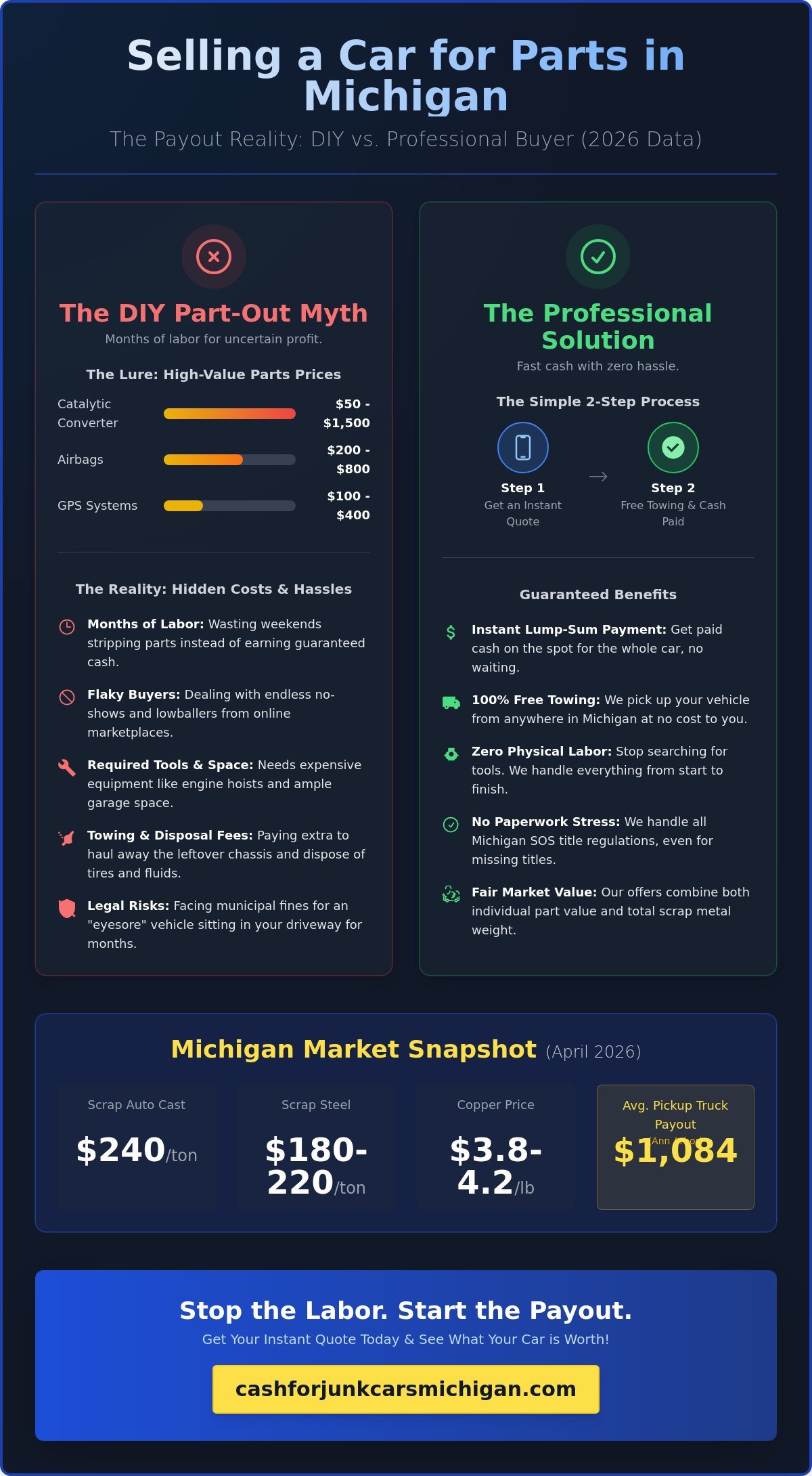
Spending your weekend pulling parts off a junk car is the fastest way to waste time and lose money in 2026. You might think stripping it yourself is the path to more profit, but the physical labor and flaky Marketplace buyers usually cost more than they’re worth. If you are looking for who buys cars for parts in Michigan, you need a solution that prioritizes speed and immediate cash. We understand the frustration of paying for towing that eats your profit or dealing with missing titles and keys.
This article shows you how to get the best cash payout for your vehicle today without the DIY headache. We’ll cover the latest April 2026 scrap prices, where auto cast is reaching $240 per ton, and explain the new title regulations revised in March 2026. You’ll discover how to secure a high payout, which averaged $1,084 for pickup trucks in Ann Arbor over the last 30 days, while getting free vehicle removal and zero paperwork stress. It’s time to stop the labor and start the payout.
Key Takeaways
- Identify the specific services that value vehicles based on components rather than drivability to maximize your return.
- Compare the “parting out” myth against selling the whole car to see why professional removal saves you time and money.
- Learn which high-demand Michigan models and parts, like catalytic converters, command the highest 2026 market prices.
- Navigate the latest Michigan SOS regulations for scrap and salvage titles to avoid paperwork delays or legal issues.
- Discover who buys cars for parts in Michigan with a simple two-step process that includes an instant quote and free vehicle removal.
Who Buys Cars for Parts in Michigan? Understanding Your Options
If you want to know who buys cars for parts in Michigan, you have three main choices: salvage yards, scrap recyclers, and professional junk car buyers. A parts-buyer is any service that values your vehicle based on its individual components rather than its ability to drive. While a dealership sees a broken engine as a liability, a parts-buyer sees a valuable source of alternators, starters, and body panels. They look at what can be salvaged and reused before the rest of the vehicle is crushed.
Local salvage yards are the most traditional option. They buy vehicles to dismantle them and resell specific parts to mechanics or DIYers. They need inventory that people actually want to buy. If you have a high-demand model like a Ford F-150 or a Honda Civic, a salvage yard might be interested. However, if your car is an obscure model with little demand, they may offer you less than the metal is worth. They are looking for resale value, not just weight.
Salvage Yards vs. Scrap Yards
Salvage yards and scrap yards are not the same business. Salvage yards focus on high-demand components like transmissions and body panels. They want parts they can clean up and put on a shelf. Scrap yards focus on the weight of the metal and the value of precious metals. As of April 2026, Michigan scrap prices for steel range from $180 to $220 per ton. Scrap yards also look for the vehicle recycling process to extract copper and aluminum. Copper is currently trading between $3.80 and $4.20 per pound. Professional buyers often pay more than a standard scrapyard because they calculate both the part value and the scrap weight into your final offer.
Private Buyers and Online Marketplaces
Selling a “parts car” on Craigslist or Facebook Marketplace is a massive headache. You’ll deal with flaky buyers who promise to show up and never do. You also have to coordinate multiple people coming to your home to pull different components. This leaves you with a skeletal frame on your lawn that still needs to be towed away eventually. It’s a slow process that rarely pays off in the long run.
Most private buyers won’t offer free towing. If you sell an engine for $300 but have to pay $150 to tow the rest of the car to a yard, you’ve lost half your profit. Professional buyers solve this by taking the whole car at once. We show up on time, pay you cash, and tow the vehicle away for free. When you consider who buys cars for parts in Michigan, remember that speed and free removal are just as important as the dollar amount on the check.
Selling for Parts vs. Selling the Whole Car: The Payout Reality
Many owners believe they’ll make thousands by stripping their vehicle piece by piece. It sounds logical on paper. You sell the engine, then the doors, then the transmission. In reality, the sum of the parts is rarely worth the months of labor required to collect the cash. If you’re searching for who buys cars for parts in Michigan, you’re likely looking for the highest Return on Investment (ROI). ROI isn’t just about the dollar amount. It’s about your time and sanity.
The Math of Parting Out
The “hot” parts of a car command impressive prices in 2026. Catalytic converters can fetch between $50 and $1,500 due to precious metal content. Airbags often sell for $200 to $800, while GPS systems go for $100 to $400. However, you have to find individual buyers for every single one of these items. This means managing dozens of online listings, answering endless questions, and meeting strangers in parking lots. You can read more in our Selling a Car for Parts: A Realistic Guide to see how these small wins compare to a single, lump-sum payment.
Stripping a car requires professional tools and significant space. Do you have an engine hoist? Do you have a torch to cut through rusted Michigan chassis bolts? Most people don’t. You also have to store the vehicle during the process. Many Michigan cities have strict municipal codes against “eyesore” vehicles. Leaving a car on blocks in your driveway can lead to expensive fines from the city before you’ve sold a single part.
Hidden Costs of DIY Part-Outs
Once the valuable parts are gone, you’re left with a “rolling chassis” that often doesn’t roll. A tow truck driver will charge a premium to move a car with no wheels or suspension. You also face disposal fees. Tires, batteries, and old interior plastics can’t go in your standard trash bin. You’ll pay out of pocket to get rid of the “junk” left behind. It’s also important to follow Michigan law regarding salvage titles when dismantling a vehicle, as improper record-keeping can lead to legal headaches.
Environmental factors are another major risk. Spilling oil, coolant, or brake fluid on your property can contaminate your soil and lead to costly cleanups. Professional buyers handle these fluids safely at dedicated facilities. Instead of risking a mess or a fine, sell your car for cash today. We handle the labor, the towing, and the environmental disposal so you don’t have to lift a finger.
Factors That Increase Your Cars Part Value in Michigan
Not every junk vehicle is created equal. When you look for who buys cars for parts in Michigan, the offer you receive depends on specific variables that drive market demand. High-volume models like the Ford F-150, Honda Civic, or Toyota Camry always command higher prices. These vehicles are everywhere on Michigan roads, which means local repair shops are constantly hunting for affordable used components. A professional guide to selling a car for parts confirms that popularity equals profit.
Valuable components often hide in plain sight. Even if the body is wrecked, a functional powertrain carries immense value. We look at several key factors when calculating your payout:
- The Catalytic Converter: This is often the most valuable single item. It contains precious metals like platinum and palladium, with payouts ranging from $50 to $1,500 depending on the model.
- Engine and Transmission: If these core units are still operational, your cash offer increases significantly.
- Alloy Wheels: Aluminum wheels are worth more than standard steel rims. In April 2026, aluminum prices sit between $0.65 and $0.85 per pound.
- Electronics: Modern modules, sensors, and GPS units are in high demand for “late model” vehicles manufactured within the last six years.
High-Demand Parts in the Midwest
Michigan’s unique climate dictates part value. Because of our brutal winters, 4WD and AWD components are prized. Transfer cases and differentials for trucks and SUVs are “hot” items. Another major factor is the condition of the body. Michigan road salt destroys metal. If you have rust-free doors, fenders, or tailgates, your car is worth more to who buys cars for parts in Michigan. Clean body panels are a rarity in the Salt Belt and sell quickly to local body shops looking for replacements.
The Role of Scrap Metal Prices
The global market sets the “floor” for your car’s value. If the parts aren’t resellable, the vehicle is valued by weight. As of April 2026, steel prices in Michigan are holding steady between $180 and $220 per ton. This ensures that even a completely stripped frame has a guaranteed cash value. You can check our latest breakdown of Scrap Car Prices in Michigan to see how weight impacts your quote. Whether your car is a high-demand truck or a rusted-out sedan, we always pay the best price based on current market data.
Michigan Regulations: Titles, Paperwork, and the SOS
The Michigan Secretary of State (SOS) updated vehicle title regulations in March 2026 to clarify the who buys cars for parts in Michigan legal process. You must understand the difference between a salvage title and a scrap title. A salvage title is required for late model vehicles when repair costs reach 75% of the pre-damaged value. If those costs hit 91%, the law requires a scrap title. A scrap title carries a $20 fee, while a salvage title costs $15. If you plan to rebuild a salvage vehicle, expect to pay a $100 inspection fee. These rules ensure that vehicles sold for parts are processed legally and safely.
Professional buyers handle the heavy lifting regarding VIN reporting. Once we buy your car, we notify the state that the vehicle is being dismantled. This prevents you from being held liable for anything that happens to the vehicle after it leaves your property. We follow the strict record-keeping requirements currently outlined in House Bill 5234, which moved to the Senate Committee on Transportation and Infrastructure on March 24, 2026. This modern approach to digital record-keeping protects sellers from future paperwork headaches.
Selling a Car for Parts with No Title
Many Michigan residents believe they can’t sell a vehicle if they’ve lost the paperwork. This is a myth. While a title is preferred, we can often buy your car using a valid registration and a driver’s license to prove ownership. We specialize in helping owners who have no keys or missing documents. Don’t let a lost piece of paper stop you from getting paid. You can follow our How to Sell My Junk Car for Cash guide to see exactly which documents you need to gather before our driver arrives.
Protecting Yourself from Liability
You must take three specific steps to protect yourself when the tow truck arrives. First, remove your Michigan license plate. This plate belongs to you, not the car. Second, cancel your insurance policy immediately. Third, ensure you receive a signed receipt or bill of sale. These steps prove you no longer own the vehicle. If you want a fast, legal sale without the stress, contact us for an instant quote today. We show up on time, pay you cash on the spot, and handle all the SOS notifications for you.
Get Cash Today: The Fast Way to Sell Your Car for Parts
Stop waiting for the “perfect” buyer to show up from a social media ad. If you want to know who buys cars for parts in Michigan with the least amount of friction, the answer is a professional direct-purchase service. We’ve streamlined the entire process into three simple steps designed to put money in your pocket today. We don’t care if the engine is blown, the transmission is slipping, or the body is rusted through from years of Michigan winters. We buy junk cars in any condition and we always pay out the best price.
Our three-step process is built for speed:
- Step 1: Get an instant quote. Call us or fill out our Michigan-wide online form. Give us the year, make, and model, and we’ll give you a firm cash offer in minutes.
- Step 2: Schedule your free pickup. We’ll come to your home, your office, or even the repair shop where your car is currently stranded. You choose the time that works for your schedule.
- Step 3: Get paid cash on the spot. Our driver arrives, handles the loading, and hands you the cash immediately. No checks to wait for and no bank transfers to track.
Same-Day Pickup Across Michigan
Our statewide network stretches from Detroit to Grand Rapids and everywhere in between. Unlike local salvage yards that only service a 35-mile radius, we cover the entire state of Michigan. This reach allows us to offer more competitive payouts. For example, over the last 30 days in April 2026, the average payout for pickup trucks in Ann Arbor reached approximately $1,084. Whether you have a compact car that averages $538 or a heavy-duty SUV, our free towing ensures you keep every penny of that quote. There are never any hidden fees or deductions for the haul-away service.
No Keys? No Title? No Problem.
We specialize in the “impossible” cases that other buyers won’t touch. If your car is missing the keys or the title, we can still help you. Our specialized equipment allows us to tow vehicles in any state of disassembly. If you started a DIY part-out and realized it was too much work, we’ll take the remaining chassis off your hands. We handle the heavy lifting while you walk away with cash. Don’t let a “parts car” take up space in your driveway for another day. Get Your Instant Cash Quote Now! and see why we’re the top choice for who buys cars for parts in Michigan in 2026.
Get Your Michigan Cash Payout Today
Stop letting that junk vehicle rust in your driveway. You now know that DIY parting out is a time-consuming gamble that often leads to municipal fines. Professional buyers are the definitive solution for who buys cars for parts in Michigan while offering the most efficient return on your investment. Whether you have a late-model wreck affected by the March 2026 title revisions or an old truck with a high-value catalytic converter, the fastest way to get paid is to sell the entire unit at once.
We make the process simple and fast. Our team provides same-day cash payments and free towing statewide in Michigan. We buy cars with no title or keys and handle the paperwork so you don’t have to. You get immediate financial relief without the physical labor or the Marketplace stress. Get Your Instant Cash Quote Today! and turn your unwanted car into cash before the sun goes down. You’ve waited long enough; get your payout now.
Frequently Asked Questions
Can I sell my car for parts if I dont have the title in Michigan?
Yes, you can sell a vehicle without a title if you have a valid registration and driver’s license to prove ownership. While state law generally requires a title, professional buyers who buys cars for parts in Michigan can navigate the legal workarounds for you. This is a common solution for owners who have misplaced documents over the years. We handle the technicalities so you can walk away with cash today without the SOS headache.
Who pays the most for cars for parts in Detroit?
Professional junk car buyers typically offer the highest payouts because they calculate both the scrap weight and the resale value of individual components. In the last 30 days, pickup trucks in the Michigan area averaged $1,084. Local yards often pay only for the metal weight, which is roughly $180 to $220 per ton for steel in April 2026. Choosing a statewide buyer ensures you get a competitive market rate based on current data.
Do I have to take the parts off the car myself before selling?
No, you do not need to remove any parts yourself before the tow truck arrives. In fact, keeping the car whole often results in a higher cash offer because it’s easier for professional equipment to load and transport. Stripping a car requires specialized tools like engine hoists and torches. We buy the entire vehicle as-is, saving you the physical labor and the cost of disposing of hazardous fluids like oil or coolant.
How much is a catalytic converter worth if I sell it separately?
A catalytic converter is worth between $50 and $1,500 depending on the precious metal content of your specific model. While selling it separately might seem profitable, it often lowers the total offer for the rest of the vehicle. Most people find that selling the whole car to who buys cars for parts in Michigan is more efficient. We factor the converter’s value into your total lump-sum cash payout to keep the process simple.
Will a junkyard pick up my car for free if it doesnt run?
Yes, reputable buyers provide free towing for non-running vehicles anywhere in the state. You should never pay a fee for vehicle removal in 2026. If a buyer tries to deduct towing costs from your cash offer, you should look for a different service. We include free pickup from your home, office, or local repair shop as a standard part of our transactional process. This ensures you keep the entire amount of your quote.
What is the difference between a salvage yard and a scrap yard?
A salvage yard focuses on reselling functional components like engines or doors, while a scrap yard values the vehicle primarily for its raw metal weight. As of April 2026, scrap steel is trading at $180 to $220 per ton. Professional buyers act as a middle ground. They evaluate your car’s part-out potential to give you a higher payout than a yard that only sees a pile of iron. This maximizes your financial return.
Can I sell a car for parts if it has a lien on it?
No, you cannot legally sell a vehicle for parts in Michigan if it has an active lien. The lienholder is technically the legal owner until the debt is paid in full. You must obtain a lien release from your bank or finance company before any transfer can occur. Once the lien is cleared, you can sell the car for cash and receive free towing on the same day. This protects you from legal liability.
What happens to my car after a parts buyer takes it?
Your vehicle undergoes a systematic recycling process where hazardous fluids are drained and valuable components are removed for resale. The remaining metal frame is crushed and sold to a scrap processor. This follows the guidelines of Michigan House Bill 5234, which emphasizes digital record-keeping and environmental safety. This process ensures that a high percentage of the vehicle’s materials are reused or recycled rather than ending up in a local landfill.