

Is that old car in your driveway just taking up space? Maybe it’s damaged, doesn’t run, or the repair bills are simply too high. You’re probably wondering if it’s completely worthless or if you can still get cash for it. The line between a ‘used car’ and a ‘scrap car’ can be blurry, and many owners don’t know where their vehicle fits. Understanding the official definition of junk cars is the first step to knowing its true value. It could be worth more than you think.
This guide cuts right to the point. We will show you exactly what qualifies a vehicle as a junk car so you can stop guessing. You’ll learn how to assess your car’s condition and discover its real cash value, even if it doesn’t start. Most importantly, we’ll outline the fastest, most hassle-free way to sell your car today, get paid on the spot, and have it towed away for free. Get the clear answers you need now.
What Officially Defines a ‘Junk Car’?
When you hear the term ‘junk car’, you might picture a rusty, abandoned vehicle. While that’s often true, the official definition is more about money and law than just looks. A car becomes junk when its problems outweigh its value. It is no longer safe, reliable, or financially practical to keep on the road.
Simply put, a car is considered junk when the cost to repair it exceeds its current market value. This status is often finalized by the state through a specific vehicle title, marking it for disposal rather than repair.
The Economic Definition: Repair Costs vs. Market Value
The most important factor is simple math. Insurance companies use a concept called ‘total loss’. If a car’s repair costs reach a certain percentage of its value (usually 50-70%), it’s declared a total loss. This same logic applies to junk cars. A major failure like a blown engine or a bad transmission on an older vehicle almost always makes it junk. Even a smaller $800 repair on a car only worth $500 makes it an economic junk car.
The Physical Condition: More Than Just Dents
While economics are key, the car’s physical state is the root cause. A vehicle is typically classified as junk due to:
- Severe Structural Damage: A bent frame from an accident or rust that has compromised the car’s integrity.
- Major Mechanical Failure: A non-running engine, failed transmission, or widespread electrical problems that are too expensive to fix.
- Missing Components: The car is missing essential parts like the engine, doors, or wheels.
- Catastrophic Damage: The vehicle has been ruined by a flood, fire, or other severe event.
The Legal Status: Salvage and Junk Titles
The government makes the ‘junk’ status official with the vehicle’s title. When an insurance company totals a car, the state often issues a salvage title. In Michigan, a vehicle with a salvage title can potentially be repaired, inspected, and retitled as ‘rebuilt’.
However, a junk title is the end of the road. This title legally designates a vehicle for dismantling and recycling only. It can never be legally registered or driven in Michigan again. Its only purpose is to be stripped for parts before the remaining metal enters the vehicle recycling process.
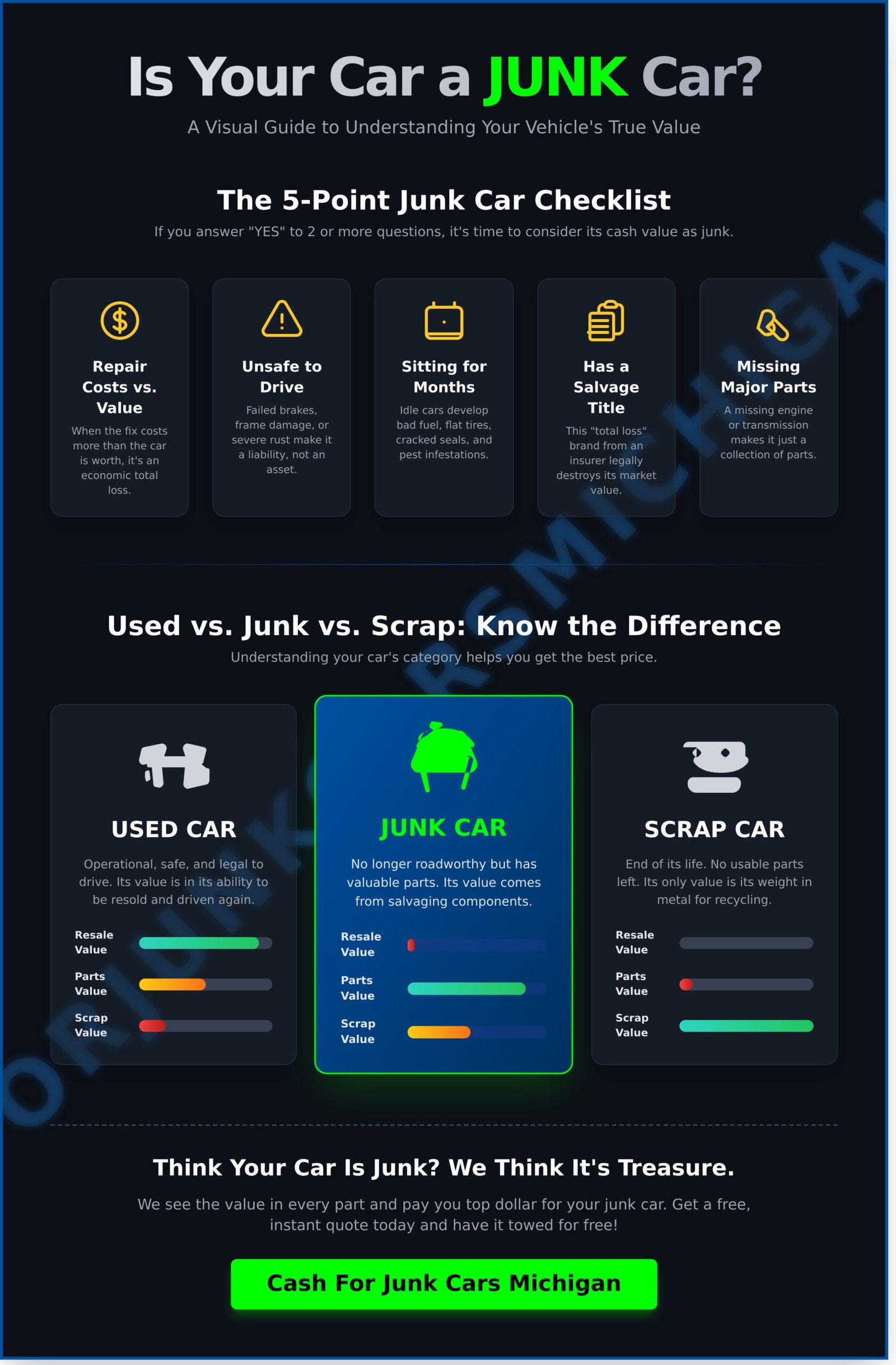
Is My Car a Junk Car? A 5-Point Checklist
You know your car is a problem, but is it officially junk? While the legal definition of a junk car can vary, especially across different states, this simple checklist will give you a fast, clear answer. If you answer “yes” to two or more of these questions, it’s time to stop worrying and start thinking about cash from Cash For Junk Cars Michigan.
1. Are Repair Costs Higher Than the Car’s Worth?
This is the most important question. First, get the car’s current market value from a site like Kelley Blue Book (KBB) or Edmunds. Next, get a written repair estimate from a trusted mechanic. If the repair bill is more than what the car is worth, it is not a smart investment. Sinking money into a car you can’t sell for a profit is the fastest way to lose cash.
2. Is the Car Unsafe to Drive?
Safety is not negotiable. If your vehicle has serious problems that make it a hazard on the road, it’s a liability, not an asset. Ask yourself if it has any of these critical issues:
- Failed brakes or a mushy brake pedal
- Frame damage from an accident
- Severe rust on the chassis or suspension components
- Broken headlights, taillights, or turn signals
- Failed a state safety or emissions inspection
3. Has It Been Sitting for Months (or Years)?
A car that doesn’t move is a car that decays. When a vehicle sits for too long, expensive problems develop. The gasoline goes bad and clogs the fuel lines, tires get flat spots, and seals dry out and crack. Worse, rodents can chew through wiring and upholstery, causing damage that is incredibly difficult and costly to fix.
4. Do You Have a Salvage Title?
A salvage title is a huge red flag for any potential buyer. It means an insurance company declared the car a total loss. Selling a car with a salvage title is extremely difficult. The process to get it re-certified for the road is expensive and complicated. This title immediately destroys the car’s market value, making it one of the classic types of junk cars Cash For Junk Cars Michigan buys every day.
5. Is It Missing Major Parts?
Is the engine, transmission, or catalytic converter gone? A car missing its core components is no longer a functional vehicle-it’s a collection of spare parts. The cost to replace a major component like an engine almost always exceeds the car’s value, making it a clear-cut junk vehicle.
Junk Cars vs. Scrap Cars vs. Used Cars: Knowing the Difference
Not all old cars are the same. The terms ‘junk car,’ ‘scrap car,’ and ‘used car’ are often used interchangeably, but they mean very different things for your wallet. The key difference is the car’s potential and its remaining value.
Understanding where your vehicle fits helps you get the best possible price. Here’s a fast breakdown to make it clear.
Junk Cars: Potential for Parts
A junk car is no longer roadworthy, but it still has valuable parts. Components like alternators, catalytic converters, transmissions, or even body panels can be salvaged, refurbished, and resold. This means the vehicle is worth more than its weight in metal alone. These are the types of vehicles we specialize in buying, because we see the value in those parts and pay you for it.
Scrap Cars: Valued by Weight
A scrap car has reached the absolute end of its life. It has no working parts left to salvage, often because it has been stripped, severely burned, or completely rusted through. Its value is determined solely by its weight and the current market price for steel. Properly recycling these vehicles is critical to minimizing the environmental impact of junk cars, as they can leak harmful fluids if left to decay.
Used Cars: Ready for the Road
A used car is simple: it’s operational, safe, and legal to drive. While it may have some wear and tear, any necessary repairs are minor compared to its market value. These vehicles are sold to private buyers or dealerships to be driven again. A used car has a future on the road; junk cars and scrap cars do not.
The bottom line is simple: a used car can be driven, a junk car can be parted out for cash, and a scrap car can only be recycled. We specialize in finding the maximum value in your unwanted car, ensuring you get paid top dollar fast.
The Lifecycle of a Junk Car: What Happens After You Sell It?
You got cash for your car, and it was towed away for free. But what happens next? Selling your car to a reputable buyer is more than just a fast transaction-it’s the first step in a highly efficient and environmentally friendly recycling process. Your old vehicle doesn’t just disappear; it gets a new life. Here’s a look at the straightforward journey your car takes from your driveway to becoming a raw material again.
Step 1: Towing and Depollution
First, your car is transported to a licensed auto salvage or recycling facility. The top priority is safety and environmental protection. Before anything else, the vehicle is depolluted. This critical step involves:
- Draining all hazardous fluids, including gasoline, oil, antifreeze, and brake fluid.
- Safely removing the battery for recycling.
- Extracting any mercury-containing switches to prevent contamination.
Step 2: Parts Harvesting (Dismantling)
Next, skilled technicians inspect the car for any valuable and reusable components. Usable parts like alternators, transmissions, tires, and body panels are carefully removed, cleaned, and tested. These parts are then inventoried and sold to repair shops and individuals, providing an affordable way to keep other vehicles on the road. This is the most profitable and eco-friendly part of recycling junk cars.
Step 3: Crushing and Shredding
Once all usable parts and hazardous materials have been removed, only the metal frame, or hulk, remains. This shell is placed in a large compactor and crushed flat for easier transportation. From there, it goes into an industrial shredder, which tears the entire frame into fist-sized chunks of metal in just a few minutes. Powerful magnets and sensors then separate the steel from aluminum and other non-ferrous materials.
Step 4: Metal Recycling
The sorted piles of metal are the final product of the auto recycling process. This scrap metal is sold to steel mills and foundries where it is melted down in massive furnaces. Recycling steel uses about 75% less energy than creating it from raw iron ore. Your old car’s metal is then repurposed into new products-it could become part of a new vehicle, a household appliance, or even the steel beams in a new building.
When you sell your car, you’re not just getting fast cash. You’re participating in a powerful recycling loop that saves energy and resources. If you’re ready to turn your unwanted vehicle into cash and raw materials, a professional service like Cash For Junk Cars Michigan can handle the entire process for you.
Why Selling Your Junk Car is the Smartest Move
Now that you know what a junk car is, you might realize you have one sitting on your property. That vehicle is more than just an eyesore-it’s a liability that costs you money, space, and peace of mind. Instead of letting it create more problems, you can solve them all today with one simple decision.
Get Instant Cash and Free Up Space
That old car is a depreciating asset taking up valuable real estate. Every day it sits, it becomes more of a burden. We turn that burden into an immediate benefit. Selling your car is the fastest way to convert a useless piece of metal into cash in your pocket.
- Turn a Problem into Profit: We put cash in your hand on the spot. No waiting, no checks, no delays.
- Reclaim Your Property: Imagine what you could do with a clear driveway, an empty garage, or a clean yard.
- Stop Wasting Money: End the pointless insurance and registration payments for a car you don’t even use.
Avoid Fines and Neighborhood Complaints
Did you know many Michigan cities have strict ordinances against inoperable vehicles? Leaving a junk car on your property can lead to warning notices, expensive fines, and even towing fees if the city removes it for you. Selling your car proactively avoids these legal headaches and keeps you in good standing with your neighbors.
The Easiest, Hassle-Free Solution
Trying to sell non-running junk cars privately is a frustrating process filled with lowball offers, no-shows, and complicated logistics. We eliminate every bit of that hassle. Our entire service is designed to be the quickest, simplest way to get rid of your unwanted car, truck, or SUV.
We handle everything from start to finish. Our team handles all the paperwork-even if you have no title, no keys, or no registration. Best of all, we offer free, same-day towing, so you don’t have to lift a finger. We come to you, pay you cash, and haul the car away for free.
Stop letting that car be a problem. Get Your Instant Quote and Cash Today!
Your Junk Car’s Next Stop: Cash in Your Pocket
Understanding the official definition of a junk car is the first step toward making a smart financial decision. You now know that if your vehicle’s repair costs exceed its market value, it’s no longer an asset-it’s a problem taking up space. Rather than letting it rust away, the best move is to sell it. This not only frees you from a burdensome vehicle but also provides an immediate cash reward. For most owners, selling is the most practical and profitable end for their old junk cars.
Ready to make that move? At Cash For Junk Cars Michigan, we turn that problem into profit, fast. We make the process incredibly simple: we pay cash on the spot and provide free towing anywhere in Michigan. Don’t let common issues stop you. We buy cars with no title and no keys-it is truly no problem for our team. We handle all the details so you can get paid without any hassle.
Your car is junk? Turn it into cash. Get a free, instant quote now! Take action today and convert that unwanted vehicle into money in your hand.
Frequently Asked Questions
How much money can I really get for a junk car?
The cash you get for a junk car depends on its year, make, model, condition, and current scrap metal prices. Heavier vehicles like trucks and SUVs often bring more cash. The best way to know the exact amount is to call us for a free, instant quote. We provide a guaranteed cash offer based on your car’s real value and pay you on the spot when we pick it up.
Do you buy junk cars without a title in Michigan?
Yes, we buy cars without a title in Michigan. While a title speeds up the process, it is not always necessary. If you have a valid driver’s license and the vehicle’s registration to prove ownership, we can handle the paperwork for you. We specialize in buying junk cars in any situation, making it easy for you to sell your unwanted vehicle for cash today.
Will you still pick up my junk car if it doesn’t run or have keys?
Absolutely. We buy cars in any condition, running or not. It makes no difference to us if your car is wrecked, damaged, or has been sitting for years. No keys? No problem. Our professional towing team is equipped to remove vehicles without keys safely and efficiently. We provide free towing for every car we buy, so you never have to worry about extra costs or hidden fees.
What’s the difference between a junkyard and a salvage yard?
A junkyard typically focuses on crushing vehicles to sell as scrap metal. A salvage yard dismantles cars to sell usable parts before recycling the remaining frame and materials. We work with an extensive network of both, which allows us to determine the best destination for your vehicle. This ensures we can always offer you the highest possible cash price for your car, truck, or SUV.
Is it better to donate my junk car or sell it for cash?
Donating a car can provide a small tax deduction, but the process is often slow and the financial benefit is not guaranteed. Selling your car to us puts cash directly in your hand, often on the same day you call. There is no paperwork hassle and no waiting for a receipt. If you want a fast, simple, and direct transaction with a guaranteed payout, selling for cash is the best choice.
How quickly can you remove my junk car?
We provide fast and reliable junk car removal. In most cases, we can schedule a pickup within 24 hours of your call. Same-day service is often available depending on your location and our driver’s schedule for the day. Our goal is to get your car removed and pay you cash as quickly as possible. Call us now to schedule your free, fast pickup and get paid today.