

What if the hours you spend sweating under a chassis to strip parts actually cost you hundreds of dollars in lost profit? Many Michigan drivers ask themselves, “should I remove any parts before junking a car” to try and squeeze out every cent. It is a logical thought. You know that catalytic converters can be worth over $1,150 for certain models and that lead-acid batteries fetch about $0.18 per pound. You want the most money possible for your unwanted asset. We understand that you do not want to be lowballed or waste your time on labor that does not pay off.
Stripping your vehicle often backfires because buyers pay the highest rates for complete cars. This article explains how removing components can slash your final quote and leave you stuck with expensive disposal fees for tires and glass. You will learn the best way to maximize your cash payout in Michigan while avoiding the stress of manual labor. We also cover how to handle the transaction legally if you have lost your title. Your goal is a fast, high-paying transaction. This guide ensures you get exactly that without any unnecessary fuss.
Key Takeaways
- Learn the financial risks and legal hurdles when deciding should I remove any parts before junking a car to ensure you get the highest possible payout.
- Discover why a complete vehicle is significantly more valuable to professional buyers than a partially dismantled chassis.
- Understand the hidden costs of stripping parts, including the labor required and the expensive disposal fees for leftover items like tires or glass.
- Follow a simple two-step checklist to clear out personal belongings and secure your Michigan license plates before the car is removed.
- Skip the hassle of the secondary parts market and find out how to get immediate payment for your junk car, truck, or SUV in its current condition.
The Big Question: Should You Strip Your Car or Junk It Whole?
Deciding should I remove any parts before junking a car depends entirely on your goals for speed and profit. If you want the fastest transaction and the highest single check, keep the vehicle intact. A complete junk car includes the engine, transmission, all four wheels, and the catalytic converter. Professional buyers prefer complete vehicles because they can efficiently process them through the vehicle dismantling industry. When you pull parts, you disrupt this efficiency and lower the car’s value to a buyer.
The secondary parts market is difficult for individuals to navigate. You might think a used starter or alternator is worth $50. In reality, buyers on social media or classified sites want parts that are tested and come with a guarantee. You may wait weeks for a buyer who never shows up. Junk car buyers calculate value based on a mix of the car’s curb weight and the resale potential of its core components. If those components are missing, the car is just a shell of low-grade steel. You lose the leverage of selling a functional machine.
Michigan scrap metal laws add another layer of complexity for DIY strippers. For example, selling a catalytic converter individually is highly regulated to combat theft. Scrap processors often require specific documentation and IDs to prove the part came from a vehicle you legally own. It is much simpler to sell the part while it is still attached to the car. Attempting to sell high-value components separately often leads to legal headaches and paperwork delays that aren’t worth the small price increase.
The Hidden Costs of DIY Part Removal
Removing parts yourself is rarely profitable when you account for your time. Pulling a transmission or engine requires specialized tools like hoists and impact wrenches. Most owners don’t have this equipment. If you spend five hours removing a part to make an extra $40, you are working for less than minimum wage. You also face storage issues. Oily, heavy parts take up space in your garage and can leak hazardous fluids onto your floor. If you’re wondering should I remove any parts before junking a car, consider the cost of the cleanup and the tools first.
How Missing Parts Affect Your Instant Quote
Missing parts trigger a deduction factor that hurts your bottom line. A buyer might deduct $50 or more from your quote for a missing battery, even if you can only get $20 for it at a local scrap yard. We offer more for cars that are intact and towable. You can see how these factors influence your payout by checking current scrap car prices. Keeping the car whole ensures the highest offer and the fastest removal from your property.
Valuable Parts People Often Try to Remove
When you ask yourself, “should I remove any parts before junking a car,” you are likely looking at the high-value components. It is a common strategy to try and sell parts like catalytic converters or batteries separately. While these are technically valuable parts to scrap, the reality of the 2026 market is complicated. Removing these items often triggers a “Deduction Factor.” This means the buyer subtracts more from your offer than you can actually make selling the part yourself. You end up with more work and less total cash in your pocket.
Car batteries are another frequent target for removal. Most lead-acid batteries weigh between 30 and 75 pounds. At the current national average scrap price of $0.18 per pound, you might only walk away with $10 or $15. However, a missing battery prevents a buyer from testing the vehicle’s electrical systems or engine. This uncertainty forces the buyer to lower their offer significantly to cover the risk of hidden mechanical failures. Similarly, high-end stereos and GPS units have lost their resale value. Most modern systems are coded to the specific VIN of the car. Once you pull them out, they become useless electronic waste that no one wants to buy.
The Truth About Catalytic Converters
Catalytic converters are the most sought-after parts because they contain precious metals like platinum, palladium, and rhodium. As of July 2026, rhodium is trading at approximately $7,200 per ounce, while platinum sits at $1,590 per ounce. This makes a single converter worth anywhere from $15 to over $1,150. However, Michigan law has strict requirements for selling these to scrap yards. You must provide a valid driver’s license and proof of vehicle ownership. Most yards will not buy loose converters from individuals without significant documentation. If you remove the converter, your junk car quote will plummet. You are usually better off selling your car whole to ensure you get the full value of these metals without the legal red tape.
Rims, Tires, and the Towing Problem
Your vehicle must be “rollable” to qualify for standard free towing services. If you strip the tires and rims, the car becomes a dead weight that cannot be winched onto a standard bed. This requires a specialized heavy-duty tow, and that extra cost will be deducted from your final payout. If you have expensive aftermarket rims, you can swap them for cheap steel spares before the tow truck arrives. Just ensure the car can still move. If the car is sitting on its rotors, it is much harder to sell and much more expensive to move. Keep the wheels on to maximize your speed and profit.
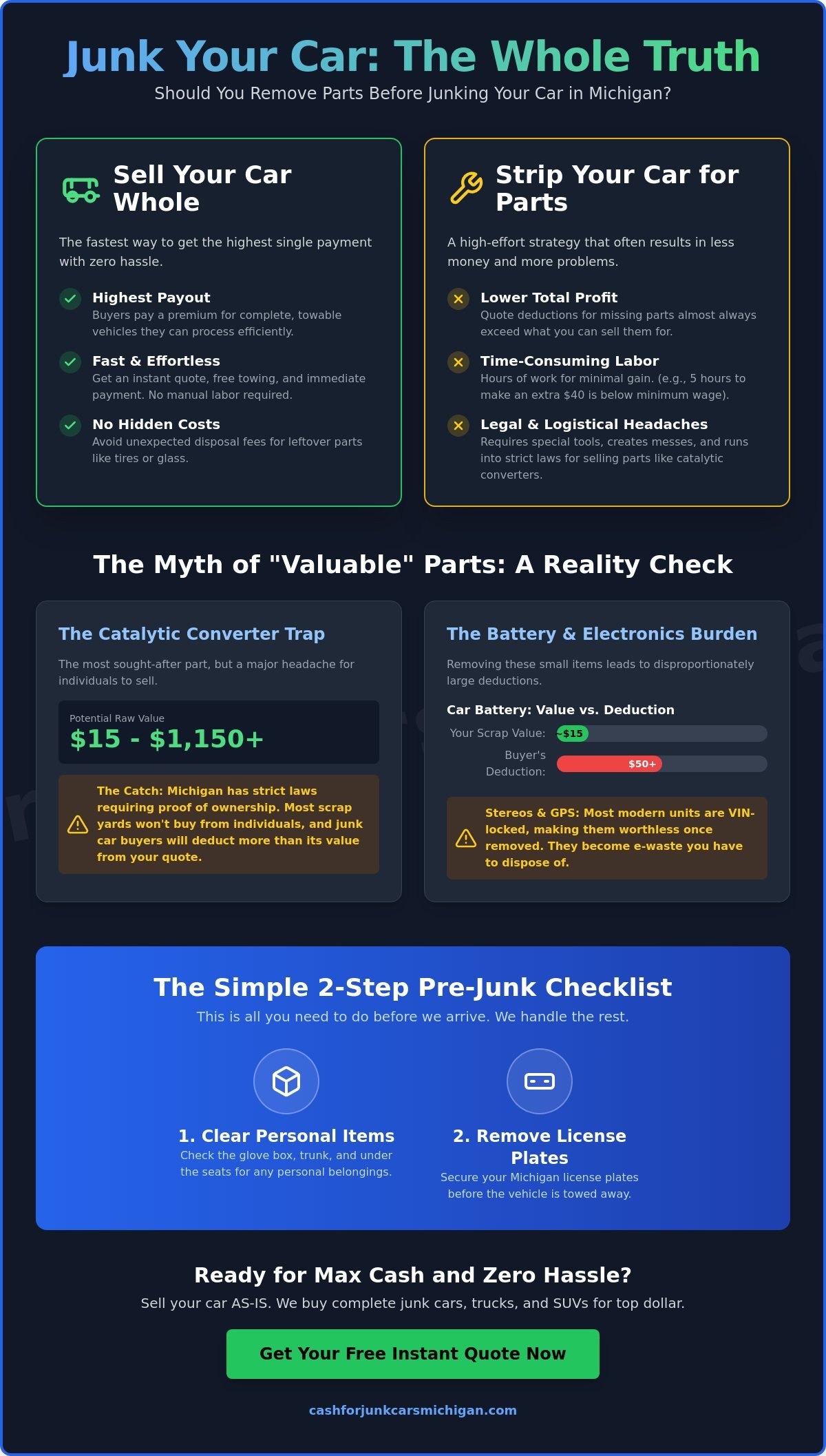
Selling a Car for Parts vs. Selling Whole
The “Half-Stripped” trap is a real danger for Michigan car owners. Many people start the process by pulling easy items, only to realize they’ve made the remaining vehicle impossible to sell. A partially dismantled car is a liability for most professional buyers. If you’ve already pulled the doors, seats, or dashboard, you’ve removed the structural integrity and resale value of the shell. When you ask should I remove any parts before junking a car, you must consider the difficulty of selling what’s left. Most reputable companies won’t touch a vehicle that’s been picked over because it’s no longer a “complete” unit for recycling. You end up with a rusted carcass in your driveway that actually costs you money to remove.
Selling the whole car is the only way to guarantee same-day cash in hand. If you try to sell individual components, you are entering the world of private sales. This requires taking photos, writing descriptions, and dealing with “no-show” buyers from online marketplaces. It’s a high-effort, low-reward strategy. For a deeper look at why this rarely pays off, read our guide on selling car for parts. You’ll find that the time spent managing dozens of tiny transactions usually outweighs the single, large check you get from a whole-car sale.
The Payout Timeline
Selling parts is a slow game. It can take weeks or even months to find a buyer for a specific alternator or a set of taillights. During that time, the vehicle sits on your property, potentially leaking fluids or attracting pests. If the parts don’t sell, you’re left with a shell that scrap yards might refuse. Selling the whole car is different. You call, get a quote, and get paid. It’s a fast-paced transaction that provides immediate liquidity. We focus on speed because we know your time is valuable. Don’t let a junker sit for months while you wait for a $20 part sale.
Logistics and Free Towing
Transportation is a hidden cost that many DIY sellers ignore. Professional free junk car removal saves you between $100 and $200 in transport fees. However, stripping the car often voids this offer. If a car is missing its wheels or is too light for a standard winch to grab safely, it becomes a logistical nightmare. Most companies won’t provide free towing for a vehicle that isn’t intact. You might also get stuck with disposal fees. In 2026, many landfills have increased “tipping fees” for tires, ranging from $2 to $5 per tire. Keeping the car whole lets the buyer handle these logistics and costs for you.
What You SHOULD Actually Remove Before Junking
While we advise against stripping mechanical components for profit, there are several things you must take out of the vehicle. These items are either personal, digital, or legal requirements that ensure a clean break from the asset. When asking should I remove any parts before junking a car, focus on your identity and personal property rather than the alternator or starter. Clearing these items now prevents delays when the tow truck arrives and protects you from future liability.
- Personal Sweep: Check under every seat, inside the center console, and deep in the trunk. People often leave behind small but vital items like spare keys, charging cables, or loose change.
- Digital Data: Modern infotainment systems store your phone contacts, call history, and home address. Perform a factory reset on the car’s computer to wipe your private information.
- Fuel Recovery: If the tank is full, you can siphon the gas into a safe container. Only do this if you have the right equipment. Most junk car buyers do not pay extra for a full tank of gas.
- Paperwork: Grab your registration and insurance cards from the glove box. You will need these to prove ownership and cancel your policy.
Legal and Administrative Tasks
The most important step is removing your Michigan license plates. You must return these to the Secretary of State or transfer them to a new vehicle. Leaving plates on a junked car is a liability risk. If that car is involved in an incident after it leaves your property, the plates could lead back to you. Removing them is the definitive way to cancel your registration and stop your insurance payments.
Handling a car with no title is a common concern in Michigan. Approximately 15% of vehicle owners in the state lose their titles annually. If you need a duplicate, the standard fee is $15, or $20 for an instant title at certain branches. However, Michigan law allows you to sell a car to a licensed processor without a title if the vehicle is at least 10 years old and worth less than $2,500. We simplify this process by handling the legal paperwork for you. For a fast, legal transaction, sell your junk car to us today.
The Personal Property Checklist
Before the tow driver hooks up the car, perform a final walkaround. Check the sun visors for hidden garage door openers or emergency cash. Inspect the CD player or DVD system for forgotten discs. These small items are nearly impossible to recover once the car reaches the recycling facility. Look in the door pockets for insurance cards or old mail that contains your address. Your goal is to hand over a clean, empty vehicle that is ready for immediate processing. This efficiency helps us pay you faster and ensures your personal data stays private.
Get Max Cash for Your Whole Car in Michigan Today
Stop stressing over the question: should I remove any parts before junking a car. The fastest way to put money in your pocket is to sell the vehicle exactly as it sits. We pay more for complete vehicles because it allows us to recycle them efficiently. When you leave the engine, transmission, and catalytic converter intact, you maximize your final payout. You avoid the labor of stripping parts and the frustration of trying to sell them to unreliable buyers. We provide a definitive, no-nonsense solution for your unwanted asset. Your goal is immediate liquidity, and we deliver it.
Our process is built for speed. You don’t need to clean the car or fix any mechanical issues. We buy Cash for Junk Cars and Cash for Junk Trucks & SUVs in any condition. Whether your vehicle is wrecked, flooded, or simply too old to drive, we want it. We handle all the logistics, including Free Junk Car Removal from your property. This saves you the high cost of hiring a private tow truck. We also manage the administrative side of the transaction. If you lack a title or keys, we work within Michigan law to complete the sale legally and quickly. We remove the barriers that slow you down.
The Easiest Way to Junk Your Car
We provide a clear, linear path to getting paid. There is no waiting for a check in the mail or dealing with complicated online payment apps. Our team is focused on completing the task quickly and correctly. Follow these simple steps for a fast transaction:
- Call us right now for an instant quote based on your intact vehicle.
- Schedule a pickup time that fits your schedule. We often arrive the same day.
- Hand over the keys and get paid cash on the spot while we tow the car for free.
We operate across the entire state of Michigan. Our team is ready to remove your vehicle and provide immediate financial relief. We bring the cash directly to you at the time of pickup. It’s the most efficient way to turn a problematic item into immediate liquidity without any fuss.
Why Michigan Residents Trust Us
We have built a reputation for fair and transparent pricing. There are no hidden fees for towing or paperwork processing. We value your time and provide straightforward answers to your questions. You get a reliable service that solves your problem. Don’t waste another weekend under a chassis trying to pull parts for a small profit. Get your instant cash offer now and let us handle the rest.
Maximize Your Payout Today
Stripping your vehicle for parts usually costs you more in lost value and labor than you will ever make in private sales. You now know that keeping your car intact is the only way to avoid the “Half-Stripped” trap. This ensures a fast, high-paying transaction without the legal hurdles of selling components like catalytic converters separately. When you ask should I remove any parts before junking a car, the answer is to keep it whole for the best financial result.
We take the stress out of the process by handling every detail from paperwork to transport. You don’t have to spend hours in the garage or deal with no-show buyers. We provide same-day service in Detroit and all surrounding areas. You get cash paid on the spot regardless of your vehicle’s condition. Free towing is included with every Michigan pickup. You keep every cent of your offer because we handle the logistics for you. If you need to clear more than just a car from your property, Clean Slate Property Service LLC provides professional hauling and junk removal for residential and commercial clients. Stop waiting and turn your unwanted car, truck, or SUV into immediate liquidity right now.
Get Cash For Your Junk Car Today – No Stripping Required!
Frequently Asked Questions
Can I keep the battery if I junk my car?
Yes, you can keep the battery, but it will reduce your final cash offer. Lead-acid batteries fetch about $0.18 per pound as scrap, but a missing battery prevents us from testing the car’s electrical systems. We recommend leaving it in the vehicle. This helps you get the highest possible price and ensures a faster transaction at your doorstep.
Will a junkyard take a car without tires?
Most junkyards won’t accept a car without tires because it is impossible to move with a standard tow truck. A vehicle sitting on its rotors requires specialized equipment that adds significant cost to the removal process. Keep the wheels on to qualify for our free junk car removal service and avoid any deductions for extra labor.
Is it illegal to remove the catalytic converter before scrapping a car in Michigan?
It isn’t illegal to remove the part, but Michigan laws make it hard to sell a loose converter to a scrap yard. You must provide specific documentation and a valid ID to prove ownership. When you ask should I remove any parts before junking a car, remember that a missing converter lowers your quote by hundreds of dollars. Keep it attached for the best result.
Do I get more money if I sell my car for parts myself?
You rarely earn more money by selling parts yourself. While parts like alternators or starters have value, finding buyers on digital marketplaces can take months. If you are researching high-end components, you can discover SuperCars.Parts to see how specialized search engines aggregate listings for exotic vehicle spares worldwide. However, for the vast majority of vehicles, the labor and storage costs outweigh the profit. We pay more for complete vehicles, giving you a single large check immediately instead of dozens of tiny, uncertain payments.
What happens if I forget a personal item in the car after it is towed?
Personal items are almost impossible to recover once the vehicle is towed to a recycling facility. We move quickly to process every car we buy, meaning your items could be lost or destroyed within hours. Always check the sun visors, glove box, and trunk one last time. Our drivers confirm the car is empty before they winch it onto the truck.
Should I drain the fluids before the tow truck arrives?
No, you should never drain the fluids yourself. Our facility is equipped to handle hazardous liquids like oil and coolant safely and legally. Attempting to drain these at home often leads to environmental spills and expensive disposal fees at local centers. Leave the fluids in the car and let our professional team handle the environmental cleanup for you.
How much does it cost to have a stripped car frame removed?
Removing a stripped frame often costs you a fee because the shell lacks enough metal to cover the towing expenses. Most scrap processors only pay top dollar for complete vehicles with heavy components like engines and transmissions. If your car is just a frame, you might lose the benefit of a cash payout. Keep the car whole to ensure you get paid.
Can I swap my new tires for old ones before junking the car?
Yes, you can swap your new tires for old ones if the vehicle stays rollable. This is a common practice if you have a set of expensive aftermarket rims or brand-new rubber. Just make sure the old tires are mounted on rims. Our tow trucks need the car to roll so we can load it quickly and get you paid on the spot.