

What if the concerns you’ve seen about donating a car combine documented reporting with claims that haven’t been verified? Separating findings from speculation can help you decide whether the problems with Kars4Kids donation matter to you.
It’s reasonable to want your vehicle to support a cause you believe in while avoiding paperwork surprises or a difficult pickup. This article explains the reported concerns, how to assess whether a donation fits your priorities, and how donating compares with selling an unwanted vehicle for cash. It also covers Michigan vehicle-transfer steps, including title transfer and license plates.
If payment and removal matter more to you than making a donation, a direct sale is another option. Cash For Junk Cars Michigan buys cars, trucks, and SUVs in any condition, provides FREE towing for vehicles it buys, and pays cash on the spot after giving a quote at pickup. The company also buys vehicles without keys, registration, or title. The sections ahead can help you weigh the options and choose a next step that fits your vehicle and priorities.
Key Takeaways
- Assess reported problems with Kars4Kids donation by separating documented findings from opinions and unverified claims.
- A court finding about advertising doesn’t automatically establish claims about every donation or program.
- Compare donation and cash sale based on what matters most to you: charitable giving, payment, removal convenience, or paperwork.
- Clarify your priorities, research the recipient, and understand the process before deciding what to do with your car.
- A cash sale can be a practical alternative for an unwanted car, truck, or SUV. Choosing it is not a judgment about charitable giving.
Problems With Kars4Kids Donation: What Concerns Are Reported?
A familiar donation jingle can make a charity easy to recognize, while critical reporting can prompt reasonable questions: Who benefits? How much goes toward fundraising? What do the ads explain? The reported problems with Kars4Kids donation involve distinct concerns, not one blanket conclusion about every vehicle or donor. Checking the source and date helps put each issue in context.
What questions do reports raise about the charity’s purpose?
In a 2017 discussion, CharityWatch raised questions about Kars4Kids’ charitable purpose and whether donors understood the cause their vehicle donations supported. The organization’s funds primarily support Oorah, an Orthodox Jewish outreach group focused on programs including youth camps, matchmaking for young adults, and trips to Israel. The Kars4Kids Wikipedia page also summarizes the organization’s mission, history, and public controversies.
For donors, the practical question is whether that mission matches their charitable intentions. Someone who expects proceeds to support a local children’s hospital, for example, may want to understand the actual beneficiary before donating. That’s a question of fit and transparency. It doesn’t establish that every donor had the same expectation or that each donated vehicle produced an identical outcome.
What fundraising concerns have been reported?
CharityWatch’s historical criticism also addressed fundraising in relation to program spending. Such assessments can help donors evaluate how an organization reports its finances, but they need context: a dated analysis describes the information and standards considered at that time. It isn’t, by itself, proof of current financial performance or evidence about how a particular car’s proceeds were used. Consider the questions about purpose, fundraising, and advertising separately.
Why have the advertisements attracted scrutiny?
Advertising concerns became the subject of a California court ruling. On May 8, 2026, a California Superior Court judge found that Kars4Kids’ ads violated California false advertising and unfair competition laws because they omitted information about the organization’s religious affiliation and the geographic focus of its beneficiaries. The ruling concerned advertising disclosures in California. It did not determine how every individual donation was handled, and a California decision does not automatically set the rules for Michigan.
NBC News reported that Kars4Kids was allowed to resume airing ads in California on June 4, 2026, while appealing the ruling. That status is separate from the judge’s finding, and the reported dispute concerns what the ads disclosed. A catchy jingle may prompt a donor to investigate, but it cannot establish where a specific vehicle’s proceeds went. Likewise, a court finding about advertising should not be stretched into a claim about every program or donation.
Bottom line: CharityWatch’s dated criticism concerns purpose and fundraising, while the 2026 California ruling addresses advertising disclosures. These are reasons to seek clarity, not proof that every donation has the same result.
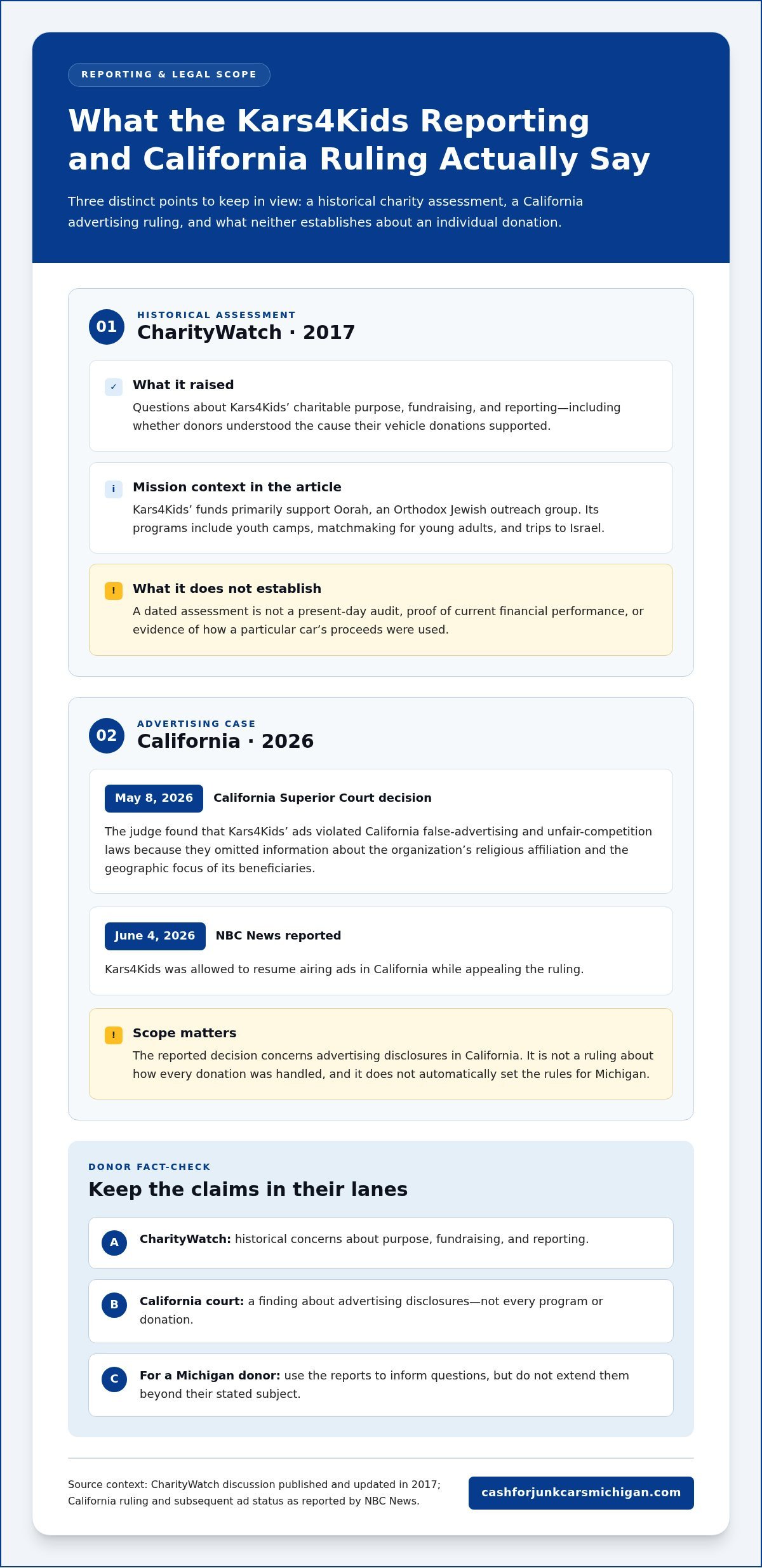
What the Kars4Kids Reporting and California Ruling Actually Say
Dates and scope matter. The historical criticism and the California advertising case address different questions, and neither proves what happened to every donated vehicle. This timeline distinguishes what was reported from what those reports can establish for a Michigan donor.
How to interpret CharityWatch’s historical criticism
CharityWatch published and updated its Kars4Kids discussion in 2017. It raised concerns about the charity’s purpose, fundraising, and reporting, including questions about how donors might understand the cause their gifts supported. These are CharityWatch’s assessments of information from that period, not a present-day audit or a finding about an individual donation. If you rely on particular figures, review the underlying records and the organization’s current disclosures.
What the reported California decision does, and doesn’t, establish
On May 8, 2026, a California Superior Court judge ruled that Kars4Kids’ advertising violated California false-advertising and unfair-competition laws. The reported finding concerned omissions in ads about the organization’s religious affiliation and the geographic focus of its beneficiaries. The court’s reported order applied to advertising in California, not to all charitable donations nationwide. NBC News reported on June 4, 2026, that the organization could resume airing ads in California while its appeal proceeded. That later development does not erase the reported finding, and the information here does not predict the appeal’s outcome.
For Michigan readers, the distinction is straightforward: this was a California legal decision, not a statement of Michigan law. It concerns advertising disclosures, not a court determination about how every donated car was processed or how every program used funds. Use these reports to inform your questions, but don’t stretch them beyond their stated subject.
Fact-checking timeline
Source and date: CharityWatch, published and updated in 2017.
Reported point: Historical criticism concerning purpose, fundraising, and reporting.
Limit: A dated assessment does not establish current performance or the outcome of a particular donation.
Source and date: California Superior Court decision, May 8, 2026, as reported by NBC News.
Reported point: The court found California advertising violated state false-advertising and unfair-competition laws due to omissions about affiliation and beneficiary geography.
Limit: The reported finding concerns advertising under California law, not every donation, program, or Michigan rule.
Source and date: NBC News, June 4, 2026.
Reported point: Kars4Kids was allowed to resume California ads while appealing.
Limit: This reports an interim status, not the appeal’s final outcome.
Use the phrase “problems with Kars4Kids donation” carefully. It can refer to reported questions, but it shouldn’t imply that every concern is a proven fact about every gift. If payment and vehicle removal matter more to you than charitable giving, compare those goals with a Michigan cash sale for an unwanted car.
Donation or Cash Sale: Which Option Fits Your Priorities?
Donation and sale are different transactions. A donation is intended to support a charitable recipient; a cash sale exchanges the vehicle for payment. Neither is automatically the better choice. Start by deciding what you want the vehicle to do for you, then compare the process, paperwork, and likely outcome.
When might donating a vehicle suit your goals?
Donation may fit if your main goal is supporting a cause and you’re comfortable with the recipient’s mission and donation process. Research who benefits, how the organization describes its programs, and what happens after pickup. Don’t assume a particular vehicle will produce a specific charitable result. If you’re considering tax treatment, consult current IRS guidance or a qualified tax professional about your own return.
For federal taxes, a deduction generally depends on eligibility and itemizing. IRS rules for the 2026 tax year set different deduction limits based on whether the charity sells the vehicle for more than $500 or for $500 or less. Those rules don’t mean every donor can claim a deduction, and they don’t determine which option is best for you.
When might a direct cash sale be more practical?
A cash sale may suit you better if payment and vehicle removal are your main priorities. Cash For Junk Cars buys junk cars, trucks, and SUVs in any condition. For vehicles it buys, towing is FREE of charge, and payment is made on the spot after a quote at pickup. The company also buys vehicles without keys, registration, or title.
Use this comparison to focus on your priorities, rather than assumptions about a charity’s impact or what a vehicle will sell for:
| Decision factor | Donation | Cash sale |
|---|---|---|
| Primary goal | Support a charitable recipient | Receive payment for the vehicle |
| Removal | Arrangements depend on the donation process | FREE towing for vehicles bought by Cash For Junk Cars |
| Payment | Not a cash sale to the owner | Cash is paid at pickup after a quote |
| Paperwork | Follow the charity’s instructions and keep relevant records | Complete the sale paperwork for the vehicle; keys, registration, or title aren’t required for a purchase |
Michigan donors should also account for the state’s vehicle-transfer steps. Sign the title over to the charity, remove the license plates, and keep a record of the donation or a photocopy of the reassigned title for 18 months. Confirm current requirements with official state guidance before completing a transfer, especially if your paperwork situation is unusual.
If reports about problems with Kars4Kids donation have you reconsidering your priorities, use the same standard for either path: decide whether charitable giving or payment matters more, then understand the transaction before handing over the vehicle. For a closer look at the sale process, see this guide to selling your car for cash.
Questions to Ask Before Donating or Disposing of a Junk Car
Before handing over the keys or arranging removal, take a few minutes to make a clear decision. A simple check can help you separate verified information from opinion, understand what happens to your vehicle, and avoid surprises in the process.
- Define your priority. Decide whether your main goal is supporting a cause, receiving cash, or getting a vehicle removed with less effort. Your priority gives you a practical way to compare choices.
- Research the recipient. Read the charity’s current materials. Identify the intended beneficiary, programs, and explanation of how vehicle donations are handled.
- Understand the process. Find out what paperwork is involved, what happens at pickup, and what records you’ll receive. Keep title, registration, and tax questions specific to your situation, and use current official guidance or qualified advice where needed.
- Compare your options. Consider the vehicle’s condition and whether cash or charitable giving better fits your needs before committing.
How can you assess a vehicle donation claim?
Start with current information from the charity, then compare it with dated, attributable reporting. A published financial assessment or court report can answer specific questions, but each has limits: older criticism isn’t automatically a description of current operations, and an allegation isn’t the same as a proven finding. The reported problems with Kars4Kids donation are a reason to check sources carefully, not to treat every unanswered question as evidence of wrongdoing.
Write down what you know, where it came from, and what remains unclear. For example, a charity’s own description may identify a beneficiary, while a dated news report may address an advertising dispute. Those sources cover different issues, so don’t use one to prove the other.
What should you consider about the vehicle itself?
Note whether the car runs, its general condition, and whether arranging removal is a priority. A non-running vehicle can make pickup logistics especially important. Then decide whether you’d rather direct its value toward a charitable cause or receive payment through a sale. Neither choice is universally right; the better fit depends on your goals and the transaction.
Condition, demand, and the vehicle’s parts can affect its potential value. Use this guide to junk car value factors in Michigan to understand what may matter, without assuming it predicts a specific offer. For practical disposal steps, follow the five-step guide to scrapping a car for cash.
If a cash sale fits your priorities, get a quote for your unwanted vehicle. Cash For Junk Cars buys junk cars, trucks, and SUVs in any condition, provides FREE towing for vehicles it buys, and pays cash on the spot after giving a quote at pickup.
A Michigan Cash-Sale Option for an Unwanted Car
A donation can be the right choice when supporting a charitable cause is your priority. A cash sale serves a different goal: getting paid for a vehicle you no longer want and arranging its removal. Considering a sale isn’t a judgment about charitable giving. It’s another practical option for Michigan owners weighing reported problems with Kars4Kids donation against their own needs.
Cash For Junk Cars buys junk cars, trucks, and SUVs in any condition. The process is direct: a quote is given at pickup, and if you accept it, cash is paid on the spot. Towing is FREE of charge for vehicles the company buys. A vehicle may be purchased even if you don’t have its keys, registration, or title.
What happens when you sell a junk car to Cash For Junk Cars?
You arrange a pickup for the vehicle, receive a quote when it’s picked up, and get cash on the spot if you proceed with the sale. The quote is provided at pickup, so general online figures aren’t a substitute for your vehicle’s quote. FREE towing is included with the purchase, so you don’t need to arrange a separate tow for a vehicle the company buys.
The company’s best-price claim applies within a 50-mile radius of the seller’s location. Same-day pickup is usual when you call early enough, but it isn’t guaranteed. These details can help you compare the sale process with a donation arrangement and decide which outcome matters most.
Before pickup, consider what you know about the car: whether it runs, its general condition, and whether keys or paperwork are available. Missing keys, registration, or title don’t automatically rule out a purchase. You can also consider whether a cash payment better fits your immediate priorities than directing the vehicle toward a charitable purpose.
How can a Michigan owner take the next step?
If you choose to donate, review the recipient and its process. If you prefer a direct sale, have basic details about the vehicle ready so you can discuss it and arrange pickup. These paths aren’t competing judgments. They serve different purposes: one focuses on charitable giving, while the other offers payment and removal for an unwanted vehicle.
For a cash sale, call 877-345-3559. Same-day pickup is usual when you call early enough. Call to discuss selling your unwanted car, truck, or SUV for cash.
Choose the Next Step That Fits Your Priorities
You don’t have to decide based on a catchy ad, a heated online claim, or pressure to act quickly. Use a clear standard: choose the option that best matches what you want to happen to the vehicle. If charitable giving comes first, take the time to understand the recipient and its process. If you’d rather turn an unwanted car into cash, focus on the practical steps for completing a sale.
The reported problems with Kars4Kids donation can be a prompt to ask better questions, not a reason to assume every donation has the same outcome. Once you’ve weighed your priorities, make a choice you’re comfortable with and move forward. A vehicle that’s been sitting unused doesn’t have to remain another task on your list.
Ready to discuss selling your junk car? Call 877-345-3559 to discuss selling your junk car for cash. Take the next step that works for you and put the vehicle behind you.
Frequently Asked Questions
What are the main problems people report with Kars4Kids donations?
Reported concerns focus on whether donors understand the charity’s beneficiaries, how fundraising and program spending are reported, and what its advertisements disclose. CharityWatch raised historical concerns in a discussion published and updated in 2017. Separately, a California court ruled on advertising disclosures in 2026. These reports explain why people ask about problems with Kars4Kids donation, but they don’t establish that every donor had the same experience or every vehicle led to the same outcome.
Is Kars4Kids a legitimate charity?
Kars4Kids operates as a charity, but “legitimate” can mean different things: legally recognized, financially transparent, or aligned with a donor’s intended cause. Critical reporting and a court ruling about advertising don’t alone establish that the organization is illegitimate. Before donating, review current charity materials and available filings, and check whether the stated beneficiaries and programs fit your expectations. If a specific concern remains, distinguish documented findings from opinion or unanswered questions.
What did the California ruling about Kars4Kids advertising say?
On May 8, 2026, a California Superior Court judge found that Kars4Kids advertising violated California false-advertising and unfair-competition laws by omitting information about the organization’s religious affiliation and the geographic focus of beneficiaries. NBC News reported on June 4, 2026, that the organization could resume airing ads in California while appealing. That dated update describes an interim status, not the appeal’s final outcome.
Does the California ruling apply to Michigan donors?
No. The reported decision concerns advertising under California law, so it shouldn’t be described as a Michigan ruling or a Michigan-specific requirement. A Michigan donor can still use the reporting to decide what questions to ask about a charity’s mission and disclosures. Keep the legal finding within its stated scope, and consult current official guidance or a qualified professional for questions about Michigan law or your own situation.
Can I donate a junk car if it does not run?
Possibly, but whether a non-running car is accepted and how it will be picked up depends on the donation program’s process. Before arranging removal, describe the vehicle accurately, including whether it starts, rolls, or has major damage. Ask what paperwork and pickup arrangements apply, and keep any donation receipt or transfer records you receive. Don’t assume every organization handles an inoperable vehicle the same way.
Can I sell a junk car without keys, registration, or a title?
Yes. Cash For Junk Cars buys vehicles even without keys, registration, or a title. If any of those are missing, explain that when discussing the vehicle so the pickup and sale can be handled with that information in mind. This can help owners with an inoperable car or incomplete paperwork consider a cash sale instead of assuming they have no option.
Is selling a junk car for cash an alternative to donating it?
Yes. A cash sale is an alternative if your priority is payment rather than directing the vehicle toward a charitable cause. The two choices have different purposes, so compare them based on what you want from the transaction. Cash For Junk Cars buys cars, trucks, and SUVs in any condition. For a vehicle it buys, towing is FREE of charge, and cash is paid on the spot after a quote at pickup.