

In Michigan, that eyesore in your driveway isn’t just a nuisance; it’s a ticking financial time bomb. If you’ve realized my neighbor complained about my junk car, you’re likely staring down a strict deadline before code enforcement arrives. Local ordinances in places like Grant Township can levy fines as high as $2,500 for every single day you’re out of compliance. It’s stressful to deal with neighborhood tension while worrying about court dates or expensive municipal liens against your property.
Putting a tarp over the car rarely works as a defense. Most codes, like those in Shelby Township, require junk vehicles to be stored in a fully enclosed building. Storing a car on grass rather than a paved surface is another common trigger for citations. For Michigan residents looking to improve their property’s compliance and value, professional Asphalt Paving creates the type of designated, clean parking area that local inspectors expect. Grass storage is often seen as a sign of permanent abandonment and can lead to environmental fines. Don’t wait for a court date to settle the matter. Get rid of the car now to avoid the daily accruing fines that some townships use to force compliance.
You deserve a solution that stops the legal clock and puts money back in your wallet. We understand the pressure of avoiding blight fines and the uncertainty of local towing laws. This article shows you how to navigate Michigan ordinances and turn your liability into immediate liquidity. You’ll learn how to resolve disputes quickly and avoid the $75 to $145 average cost of a local tow. We’ll cover the specific penalties in your area and show you how to get cash for junk cars and trucks while securing free junk car removal today.
Key Takeaways
- Identify the specific triggers like safety hazards and pests that cause neighbors to report your vehicle to local authorities.
- Understand how Michigan blight ordinances work and why daily fines can reach thousands of dollars in some townships.
- Discover the immediate steps to take once my neighbor complained about my junk car to prevent legal action or property liens.
- Learn how to secure cash for junk cars and trucks while using free junk car removal to end the dispute instantly.
Understanding Why Your Neighbor Complained About Your Junk Car
Finding out that my neighbor complained about my junk car is a stressful experience. You might feel targeted or frustrated, but you must act quickly. A complaint usually signals that your vehicle has crossed the line from a personal project to a community problem. Neighbors don’t just complain because they’re bored. They often worry about real issues like rodent infestations, safety hazards for local children, and the overall decline of the street’s appearance. In Michigan, these complaints often trigger inspections from local code enforcement officers.
There is a major legal difference between a simple disagreement and a violation of public nuisance laws. A private nuisance affects one person, but a public nuisance impacts the health and safety of the entire community. Once a city official gets involved, your car is no longer just your business. It becomes a matter of municipal blight. You need to resolve the situation before the city issues a formal citation or schedules a court date. The clock starts ticking the moment that complaint is filed.
Is Your Car Legally a ‘Junk Vehicle’?
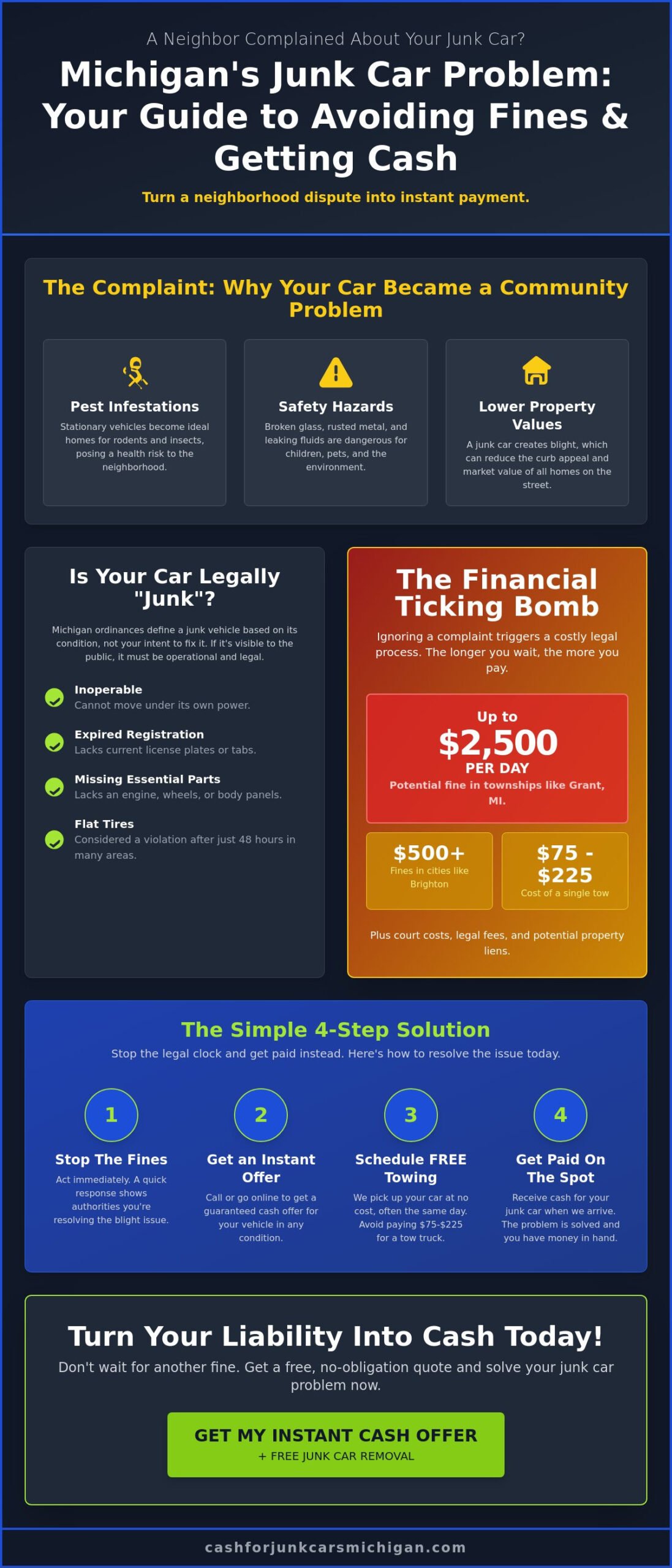
Local Michigan ordinances use specific criteria to define a junk vehicle. You don’t need a rusted out frame for a car to qualify as blight. Most municipalities look for these specific indicators:
- Flat tires: In many areas, tires that remain flat for more than 48 hours are a violation.
- Expired registration: Unlicensed vehicles are rarely allowed to sit in plain view.
- Missing parts: If the car lacks an engine, transmission, or essential body panels, it’s a junker.
- Inoperability: If the vehicle cannot move under its own power, it’s a liability.
Your intent to fix the car doesn’t matter to the law. Many owners claim they’re working on a “hobby project,” but ordinances usually require these projects to stay inside a fully enclosed garage. If it’s sitting on your lawn or driveway, it’s a legal liability. When my neighbor complained about my junk car, the city focused on the current condition, not your future plans.
The Role of Property Values and Neighborhood Aesthetics
Curb appeal is a major factor in residential real estate. A single junk car can negatively impact the market value of every home on your block. Neighbors view an abandoned or broken-down vehicle as a sign of property neglect. This creates social pressure that leads to formal complaints. If you live in an area with a Homeowners Association (HOA), the rules are even stricter than city code. HOAs can often issue their own fines and legal threats. Even without an HOA, city code enforcement has the power to tow your vehicle and bill you for the service. You should handle the complaint immediately to protect your reputation and your finances.
Michigan Blight Ordinances and Junk Vehicle Laws You Should Know
Michigan law gives local governments broad power to remove unsightly vehicles from residential properties. While the Michigan Vehicle Code provides a baseline, Michigan’s abandoned vehicle laws allow municipalities to set their own strict rules. If you’ve realized my neighbor complained about my junk car, you’re now subject to these local codes. In Grant Township, for example, a tagged vehicle can be towed just three days after a warning. Once that tag is on your windshield, the legal process has already started. You don’t have much time to act before the city takes control of your property.
Local ordinances often define “blight” as anything that creates a visual or physical nuisance. This isn’t just about rust or broken glass; it’s about how the vehicle impacts the safety and value of the community. If your car is missing essential parts or lacks a current license plate, it’s a primary target for code enforcement. You can get a price for your vehicle before these legal penalties start piling up and draining your bank account.
Local Ordinance Variations (Detroit vs. Rural Michigan)
Enforcement varies wildly depending on your zip code. In high-density cities like Detroit, the focus is on rapid removal to prevent urban decay. The Tow Rate Commission in Detroit recently proposed increasing flat-rate tow fees to $225 for standard vehicles. Rural areas like Winfield Township might start with lower fines, such as $50 for a first offense. However, repeat violations in cities like Brighton can quickly escalate to $500 plus costs. You should check your specific township’s website for their “Blight” or “Nuisance” ordinance to see exactly how much time you have left. Most cities post these documents online under their zoning or building departments.
The Legal Definition of ‘Inoperable’ in Michigan
The “Inoperable Vehicle” trap catches many owners off guard. A car doesn’t have to be a total wreck to be illegal. Michigan authorities typically use a simple test to determine status. Does it have a working engine? Are all the tires inflated? Is the registration current? If the answer to any of these is “no,” the car is legally inoperable. Even a clean car with a dead battery can be cited if it sits for too long.
Putting a tarp over the car rarely works as a defense. Most codes, like those in Shelby Township, require junk vehicles to be stored in a fully enclosed building. Storing a car on grass rather than a paved surface is another common trigger for citations. Grass storage is often seen as a sign of permanent abandonment and can lead to environmental fines. Don’t wait for a court date to settle the matter. Get rid of the car now to avoid the daily accruing fines that some townships use to force compliance.
The Real Cost of Keeping a Junk Car After a Complaint
Ignoring a complaint won’t make it go away. It just makes it more expensive. Once my neighbor complained about my junk car, I entered a high-stakes financial race. In Michigan, blight violations aren’t simple one-time tickets. They are often daily offenses. In Grant Township, you could face fines between $100 and $2,500 for every single day the car remains. That’s not just a penalty; it’s a financial catastrophe. These costs quickly outpace the actual value of the vehicle. You’re paying for the privilege of keeping a liability on your lawn.
Beyond the fines, you face abatement costs. This happens when the city takes direct action to remove the nuisance. They hire a private company to tow the vehicle and then they send you the bill. This process is backed by Michigan’s abandoned vehicle laws, which give municipalities the power to clear blight quickly. If you don’t pay, the city can place a lien on your property title. You won’t be able to sell or refinance your home until that debt is cleared. You also lose money on hidden issues. Stationary junk cars attract rodents and pests. They kill the grass underneath, leading to soil contamination and expensive lawn restoration needs.
Blight Fines and Court Costs in Michigan
A small $50 ticket can snowball into a $500 court judgment in a matter of weeks. In Winfield Township, a first repeat offense jumps to $250. A second repeat offense hits $500 plus costs. If you live in Brighton, the fourth offense is a guaranteed $500 fine. Dealing with Michigan’s local district courts is time-consuming and stressful. You’ll spend hours in a courtroom instead of earning money. If the city decides to pursue a ‘Clean and Lien’ action, they might even charge you for the administrative time spent processing your violation.
Towing and Storage Fees: The Financial Sinkhole
If the city tows your car, the financial bleeding accelerates. A local tow in Michigan typically costs between $75 and $145. This often includes a base fee plus $4 per mile. If the tow happens after 8 p.m. or on a weekend, expect a 45% surcharge. Once the car hits the impound lot, storage fees start. These fees can reach $30 to $50 per day. In many cases, the total bill for towing and storage ends up being higher than the current scrap car prices. You could end up in a ‘Total Loss’ scenario where the city sells your car at auction, but you still owe the original fines and court costs. Don’t let a junk car bankrupt you. Resolve the issue now before the city takes the choice out of your hands.
How to Handle a Neighborhood Complaint Without Getting Fined
You need a plan of action immediately. Once my neighbor complained about my junk car, the situation shifted from a private matter to a legal race against the clock. You can stop the fines if you act before the city inspector returns for a follow-up. Follow these five steps to protect your property and your bank account:
- Step 1: De-escalate with the neighbor. If it’s safe, speak with them. Acknowledge their concern and provide a specific date for removal.
- Step 2: Document everything. Take clear photos of the vehicle and where it’s parked. This protects you if the city claims the car was on public property when it was actually in your driveway.
- Step 3: Move the vehicle. Most Michigan ordinances, like those in Shelby Township, allow outdoor storage only if the car isn’t visible from the street. Move it into a garage if you have one.
- Step 4: Research removal options. Don’t wait for a city-contracted tow truck. They’ll charge you for the service and keep the car.
- Step 5: Call a professional buyer. Turn the liability into liquidity by selling the car before the next inspection.
Taking these steps shows “good faith” to local authorities. You can get an instant quote right now to show the city you have a professional removal plan in place.
De-Escalation Tactics for Hostile Neighbors
A hostile neighbor is usually a frustrated neighbor. They want the eyesore gone. Use a direct script: “I apologize for the delay. I’ve already scheduled a pickup for this week, and the car will be gone by Friday.” Don’t promise to “fix it next weekend” unless you’re 100% certain. Failed promises lead to second complaints, which often result in immediate citations rather than warnings. Being proactive stops the neighbor from calling code enforcement a second time.
Managing the Code Enforcement Officer
If you find a green tag on your window or a ‘Notice of Violation’ in the mail, don’t panic. Officers have some discretion. You can often request a short extension for junk car removal if you show proof of a scheduled sale. Sometimes, simply cleaning up the area around the car helps. Mowing tall weeds or removing trash from the dash can signal that you’re maintaining the property. This might buy you the 48 to 72 hours you need to finalize a deal and get the car off your lot for good.
Get Cash for Your Junk Car and End the Dispute Today
You don’t have to let a neighborhood dispute ruin your week or drain your savings. Cash For Junk Cars Michigan provides the “instant resolution” button you need to stop the legal clock. When my neighbor complained about my junk car, I realized that every hour the vehicle sat was a gamble with code enforcement. We offer a fast, transactional solution that removes the liability from your property and replaces it with immediate liquidity. Our service covers the entire state, providing a reliable way to clear blight before the city takes action.
Administrative barriers often stop people from acting. You might think you can’t sell the vehicle because you lost the keys or the title is missing. We solve that problem. We buy junk cars, trucks, and SUVs regardless of their condition or paperwork status. Our team handles the logistics so you don’t have to. By choosing our free junk car removal service, you avoid the $145 towing fees and the $50 daily storage rates common at Michigan impound lots. We take the car; you keep the cash.
The 3-Step Removal Process
Our process is designed for speed and efficiency. We value your time and get straight to the point. You can resolve your blight issue in three simple steps:
- Call for an instant quote: We provide no-nonsense pricing based on the current scrap car prices in Michigan.
- Schedule your free tow: We offer rapid pickup options across the state. We work around your schedule to ensure the car is gone before your city’s deadline expires.
- Get paid on the spot: We hand you cash the moment we load the vehicle. You turn a neighborhood complaint into a payday without any hidden fees.
Why Professional Removal Beats ‘Fixing it Later’
Many owners fall into the trap of promising to repair the vehicle. In reality, the cost of parts and professional labor usually exceeds the car’s market value. If you try selling a car for parts yourself, you’ll deal with months of low-ball offers and strangers visiting your property. Code enforcement won’t wait for your hobby project to finish. They want the nuisance gone now. A professional buyer is the only way to meet a 48-hour or 72-hour blight deadline. Don’t wait for the city to tow your property and send you a bill. End the neighbor drama and sell my junk car today for immediate relief.
Resolve Your Michigan Blight Issue Today
Michigan blight laws don’t wait for your schedule. Now that you know how to act when my neighbor complained about my junk car, you can take control of the situation before the city takes control of your property. You’ve learned that local ordinances are aggressive and fines accumulate daily. Professional removal is the fastest path to de-escalating neighborhood tension and protecting your property title from municipal liens. You don’t have to spend money on expensive towing or waste time hunting for missing paperwork.
We provide a no-nonsense solution that turns your problematic asset into immediate liquidity. We offer same-day pickup throughout Michigan and pay cash on the spot regardless of the vehicle’s condition. Even if you don’t have the title or keys, we handle the administrative hurdles for you. Stop the stress of neighborhood conflict and municipal citations right now. Get an Instant Quote and Schedule Your Free Removal Now. It’s time to clear your driveway and get paid.
Frequently Asked Questions
Can a neighbor report me for a car in my own driveway in Michigan?
Yes, neighbors can report vehicles that violate local blight and nuisance ordinances. Most Michigan municipalities regulate “junk vehicles” even when they sit on private property. If the car is inoperable, unlicensed, or missing major parts, code enforcement has the authority to issue citations. Your private driveway is not a shield against local blight laws.
How long do I have to move a junk car after a complaint?
The timeline depends on your specific township or city code. In Grant Township, officials can tow a vehicle just three days after it is tagged with a warning. Other municipalities might offer a 7 or 14 day grace period. You must check the “Notice of Violation” for the exact deadline to avoid immediate towing and storage fees.
What happens if I ignore a blight citation for a junk vehicle?
Fines will accumulate every day the violation remains on your property. In some Michigan townships, these fines range from $100 to $2,500 per day. If you don’t act, the city can tow the car at your expense and place a lien on your home. This prevents you from selling or refinancing your property until the debt is cleared.
Can the city tow my car if it’s parked on my private property?
Yes, Michigan law allows municipalities to abate public nuisances on private land. If your vehicle meets the local definition of “junk” and you ignore the warning period, the city can hire a private tow company to enter your property. You’ll be responsible for the towing bill and all daily impound storage costs.
Do I need a title to sell my junk car to a removal service in Michigan?
No, you don’t always need a title to sell your vehicle for scrap. While a title is preferred, professional removal services can often handle the paperwork for vehicles without titles or registration. This is the fastest way to resolve the issue if my neighbor complained about my junk car and I can’t find the original documents.
Is it illegal to keep a non-running car under a tarp in Michigan?
Yes, tarps are usually not considered legal storage for inoperable vehicles. Most ordinances, such as those in Shelby Township, require junk cars to be stored inside a fully enclosed building like a garage. If the vehicle is visible from the street or a neighbor’s property, a tarp will not protect you from a blight citation.
How much is the average blight fine for a junk car in Detroit?
Detroit blight fines often start at $50 for a first offense, but the real costs are much higher. The Detroit Tow Rate Commission recently proposed a flat-rate tow fee of $225 for standard vehicles. When you add daily storage fees and potential court costs, a single complaint can easily cost you several hundred dollars in a matter of days.
Can I get in trouble for a car that doesn’t have an engine?
Yes, a car without an engine is legally “inoperable” and qualifies as a junk vehicle in almost every Michigan jurisdiction. Blight codes specifically target vehicles that are missing essential parts like engines, transmissions, or wheels. If the car cannot move under its own power, it is a violation that can trigger a neighbor complaint and city fines.