

Did you know that the difference between a compact sedan and a full-size SUV can mean an extra 3,000 pounds of metal on the scale? It’s frustrating to look at a non-running vehicle and wonder if a scrap yard is going to lowball you. Most owners feel confused by technical terms like GVWR or curb weight when all they want is a fair price. Getting accurate junk car weight estimates is the only way to protect your profit and ensure you receive the highest possible cash payout today.
You deserve a fast, no-hassle transaction that puts money in your pocket immediately. We understand the logistical stress of moving a heavy truck that doesn’t start. This guide explains how to find your vehicle’s true weight using the door jamb sticker or manufacturer data. You’ll also learn how current Michigan scrap metal trends impact your final offer. We’ll show you how to turn that heavy eyesore into immediate liquidity without any unnecessary fuss.
Key Takeaways
- Understand why total metal mass determines the baseline cash offer for your junk vehicle.
- Locate your VIN or door jamb sticker to find reliable junk car weight estimates without a commercial scale.
- Learn the difference between curb weight and net scrap weight to avoid confusion during the final transaction.
- Compare average weights across vehicle classes to see why SUVs and trucks typically net higher payouts.
- Discover how to secure a high cash offer and free towing for your heavy car or truck today.
Why Junk Car Weight Estimates Determine Your Payout
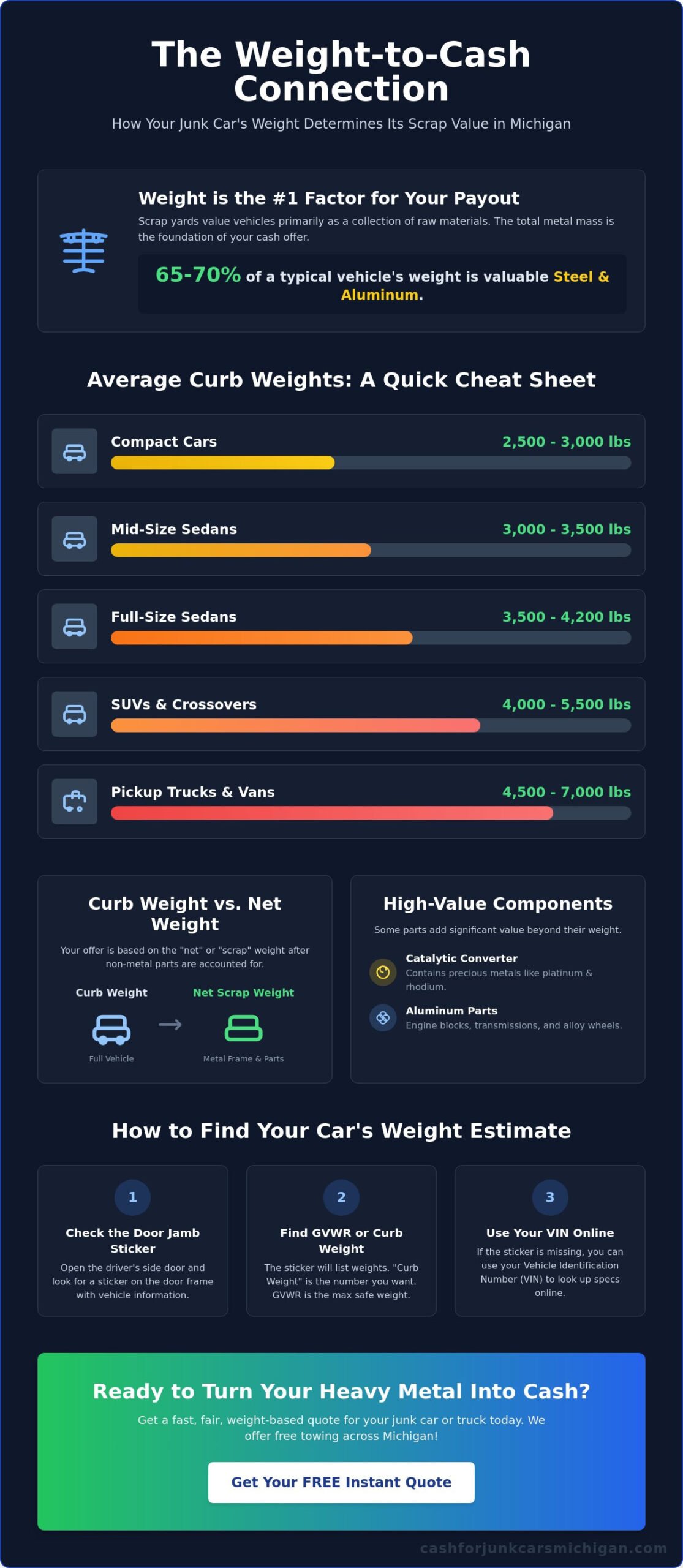
Weight is the primary metric scrap yards use to calculate your baseline cash offer. When a vehicle reaches the end of its life, it is no longer valued as a mode of transportation. Instead, it is treated as a collection of raw commodities. Steel and aluminum make up roughly 65-70% of a vehicle’s total mass, forming the foundation of the quote you receive. Understanding your junk car weight estimates allows you to verify that the offer matches the actual metal content of your car, truck, or SUV.
While the scale provides the starting point, certain components provide value that exceeds their physical weight. The catalytic converter is the best example. These parts contain precious metals like platinum, palladium, and rhodium. An intact converter can add significant value to your payout, even on a lightweight compact car. Market fluctuations in Michigan scrap prices also play a role. These rates change daily based on global demand and local supply, directly impacting the per-ton rate offered by buyers across the state.
The Role of Ferrous and Non-Ferrous Metals
The type of metal in your vehicle is just as important as the total poundage. Ferrous metals, which contain iron, make up the bulk of the chassis and body panels. These are the heaviest parts of the car but typically carry a lower price per pound. In contrast, non-ferrous metals like aluminum are found in engine blocks, transmission cases, and alloy wheels. Aluminum fetches a higher price at the scrap yard. The Curb weight of your vehicle gives a total number, but the specific mix of these metals is what truly determines the final value. A vehicle with more aluminum components will often net a better payout than a heavier car made primarily of low-grade steel.
How Michigan Scrap Markets Affect Your Estimate
Michigan is a unique market because of its position in the Midwest automotive corridor. Local demand for recycled steel remains high to support regional manufacturing. However, scrap car prices can vary significantly between cities like Detroit and more rural areas. Transportation costs to processing facilities often dictate these regional differences. Scrap value is the commodity price of raw materials minus processing costs. When you provide accurate junk car weight estimates, you help buyers calculate these margins quickly. This leads to a faster transaction and a more reliable cash offer for your unwanted asset.
Average Weights by Vehicle Class: A Quick Cheat Sheet
Most junk car weight estimates start with identifying the vehicle’s class. A compact car is the baseline for most offers. Larger vehicles like SUVs and pickup trucks offer more raw material, which leads to higher payouts. Use the following categories to understand where your vehicle sits on the scrap scale:
- Compact Cars: 2,500 – 3,000 lbs
- Mid-Size Sedans: 3,000 – 3,500 lbs
- Full-Size Sedans: 3,500 – 4,200 lbs
- SUVs and Crossovers: 4,000 – 5,500 lbs
- Pickup Trucks and Vans: 4,500 – 7,000 lbs
Small to Mid-Size Sedans (2,500 – 3,500 lbs)
Compact cars like the Honda Civic or Toyota Corolla typically weigh between 2,500 and 3,000 pounds. Mid-size sedans like the Chevy Malibu or Ford Fusion fall into the 3,000 to 3,500-pound range. Older sedans often weigh more than modern, plastic-heavy versions. Manufacturers now use lighter materials to meet fuel standards. This means a non-running car from 2005 might actually have a higher scrap-only value than a 2020 model of the same size. You can expect these vehicles to be the most common type processed for scrap. If you have a sedan taking up space, you can get a fast quote from Cash For Junk Cars Michigan to see what it is worth today.
Full-Size SUVs and Pickup Trucks (4,500 – 7,000 lbs)
Full-size SUVs and pickup trucks are the heavyweights of the automotive world. Models like the Ford Explorer or Chevrolet Silverado range from 4,000 to 6,000 pounds; heavy-duty variants often exceed 7,000 pounds. These vehicles have heavy frames and large engines that significantly increase the total steel tonnage. A junk truck is often worth 50-100% more than a sedan simply because there is more raw material to process. The recycling of metals from these larger frames is a major part of the automotive secondary market. Heavy-duty components like transmissions and axles add even more to the final cash offer.
Electric Vehicles (EVs) present a unique challenge for junk car weight estimates. Their battery packs can weigh 1,000 pounds or more, making them much heavier than traditional cars. While the weight is high, the value depends on the yard’s ability to process lithium-ion components. Traditional SUVs and crossovers usually sit in the middle, weighing between 4,000 and 5,500 pounds. They are popular scrap items because they offer a consistent balance of steel and aluminum. Turn your heavy vehicle into immediate liquidity by choosing a buyer that values weight accurately.
Curb Weight vs. Net Weight: The Junk Yard Reality
Many vehicle owners look at their owner’s manual and assume the listed weight is exactly what they will get paid for at the scrap yard. This is a common mistake. Most manuals list the Curb weight, which includes a full tank of gas, oil, coolant, and transmission fluid. Scrap yards buy metal; they do not pay for gasoline or wiper fluid. When you provide junk car weight estimates to a buyer, you must account for the difference between the gross weight and the net weight of the actual steel and aluminum.
The vehicle is considered the most recycled consumer product in the world because of its high metal content. However, the yard pays based on the “dry weight.” This is the mass that remains after all fluids are drained and non-metal components are accounted for. If your car is missing major mechanical parts like the engine or transmission, your estimate will drop by hundreds of pounds instantly. These heavy components represent a large portion of the vehicle’s total tonnage and financial value.
Common Weight Deductions at the Scrapyard
Recyclers have to deal with “contaminants” that don’t have scrap value. These items take up space and require disposal, which costs the yard money. Most vehicles contain between 500 and 800 pounds of “dead weight” that does not contribute to your final payout. Common deductions include:
- Plastic dashboards, door panels, and interior trim.
- Rubber tires and safety glass, which are often viewed as disposal liabilities.
- Fabric seats, carpeting, and foam insulation.
Recyclers often apply a standard percentage deduction to account for these materials. This ensures they only pay for the raw materials they can actually resell to mills. Understanding this reality helps you set realistic expectations for your cash offer. Don’t be surprised when the scale weight is lower than the manufacturer’s spec sheet.
The Importance of a Whole Vehicle
Stripping a vehicle might seem like a way to make extra money, but selling car for parts usually reduces the remaining scrap value significantly. A “complete” junk car includes the battery, catalytic converter, and original engine. Removing these items takes away the most valuable metals and the heaviest components. If the engine is missing, your junk car weight estimates will be much lower, resulting in a smaller check. We prioritize complete vehicles and offer better rates for cars that haven’t been picked apart. Keeping the car intact ensures you get the highest possible tonnage and a faster, more efficient transaction.
How to Find Your Car’s Weight Estimate Without a Scale
Finding the weight of a non-running vehicle shouldn’t be a guessing game. You don’t need a commercial truck scale to get accurate junk car weight estimates. Most owners no longer have the original owner’s manual; however, the information is still physically attached to the car. Start by locating the 17-digit Vehicle Identification Number (VIN) on the lower driver-side dashboard or the door frame. This number is the key to unlocking the exact manufacturing specifications of your vehicle.
Decoding the Door Jamb Sticker
Open the driver’s door and look for the Safety Compliance Certification Label. This sticker contains several weight ratings that often cause confusion. You will likely see the Gross Vehicle Weight Rating (GVWR). This is not the weight of the car itself; it is the maximum allowable weight including a full load of passengers and cargo. To find the scrap value, you need the curb weight. If the sticker only shows GVWR, you can estimate the weight by subtracting the average payload capacity. For most sedans, this means subtracting roughly 900 to 1,000 pounds. Commercial vehicles and heavy-duty trucks may also list a “Tare Weight,” which represents the actual weight of the empty vehicle as it left the factory. This is the most accurate number for your scrap calculation.
Using the VIN for Instant Specs
If the sticker is faded or missing, use a free online VIN decoder. These tools provide instant manufacturing data based on your specific serial number. Details like the trim level are vital for accurate junk car weight estimates. For example, a Chevrolet Tahoe LT might weigh significantly less than a Tahoe LTZ equipped with a heavy sunroof, larger wheels, and additional power components. These differences can change the weight by 200 to 400 pounds. Verifying the engine size through the VIN also helps estimate the non-ferrous metal content. Larger V8 engines contain more cast iron or aluminum than a standard four-cylinder, which impacts the final price.
Cross-reference these specs with the official definition of junk cars to see if your vehicle qualifies for a weight-based buy. Once you have your numbers, you can move forward with confidence. If you want an immediate price without doing the math, get a quote from Cash For Junk Cars Michigan today. We handle the calculations and provide free towing for any vehicle regardless of its condition. Don’t waste time with complicated scales when the data is already at your fingertips.
Get Your Michigan Junk Car Weight-Based Quote Today
You now know how to calculate junk car weight estimates. Now it’s time to turn that data into liquidity. We pay more for heavy vehicles because we value the raw metal content accurately. Whether you have a compact sedan or a heavy-duty pickup, we provide a fair price based on the actual tonnage. This transparent, weight-based pricing model is also used by specialists like Rapid Car Removal to ensure sellers get the best market value. You don’t have to worry about the logistics. We move massive, non-running assets every day. We handle every part of the process for you.
The Cash For Junk Cars Michigan Advantage
We specialize in heavy vehicle removal across the entire state. Our pricing is transparent and reflects the current 2026 Michigan scrap metal rates. Because we are a direct-to-buyer service, there are no middleman fees cutting into your payout. You get the full value of your scrap metal. We also overcome the administrative hurdles that stop other buyers. If you have no title or no keys, we still buy based on the vehicle’s weight. This problem-solving approach makes us the most reliable choice for your junk car removal.
How to Get Your Quote in 60 Seconds
Getting your money is a simple, three-step process. First, call us with your vehicle’s make, model, and general condition. We use your junk car weight estimates to generate a firm offer immediately. You will receive a quote based on our proven sell my junk car framework. This ensures you get the highest possible payout for your specific vehicle class. We don’t use vague estimates; we use market data.
Once you accept the offer, we schedule your free pickup. Our team arrives at your location, handles the paperwork, and pays you cash immediately. There is no sentimentality and no fuss. We are here to complete the task quickly and correctly. Turn your unwanted asset into immediate cash today. Call us now to get your weight-based quote and clear your driveway. We are ready to buy your vehicle right now.
Turn Your Vehicle Weight Into Immediate Cash
You now have the tools to verify your vehicle’s value with confidence. You understand that the weight listed in your manual is just a starting point. The real value comes from the net metal weight after fluids and non-metal parts are removed. These accurate junk car weight estimates ensure you get a fair price for every pound of steel and aluminum. Don’t let a heavy, non-running truck or SUV sit in your driveway when it could be immediate liquidity. We have been buying junk cars in any condition since 2010. Our team provides free towing statewide and ensures same-day cash payouts regardless of where you are in Michigan. We handle the heavy lifting, the towing, and the paperwork so you don’t have to. Stop guessing what your scrap metal is worth and start getting paid. Get Your Instant Cash Offer Based on Your Car’s Weight Now! We are ready to clear your space and put money in your pocket today.
Frequently Asked Questions
How much does a standard sedan weigh for scrap?
A standard mid-size sedan typically weighs between 3,000 and 3,500 pounds at the curb. However, your scrap payout is based on the net weight after non-metal parts are removed. This usually leaves 2,500 to 3,000 pounds of recyclable metal. Compact models will weigh less; full-size luxury sedans can exceed 4,000 pounds. We use these figures to provide accurate junk car weight estimates before we arrive.
Do junk yards weigh the car with me in it?
No, scrap yards do not weigh the vehicle while you are inside. They use large industrial scales that are calibrated for the vehicle alone. You must exit the car before it is driven onto the scale. If the yard uses a drive-on scale, they will weigh the tow truck and trailer empty afterward to calculate the “tare” weight. This process determines the true mass of your junk car.
What is the difference between GVWR and Curb Weight?
Curb weight is the weight of the empty vehicle with all fluids and a full tank of gas. GVWR stands for Gross Vehicle Weight Rating; it is the maximum weight the car can safely carry including passengers and cargo. For your junk car weight estimates, always look for the curb weight. The GVWR is often 1,000 pounds higher than the actual scrap metal content available in the chassis.
How much weight is deducted for tires and fluids?
Scrap yards typically deduct between 500 and 800 pounds for non-metal contaminants. This includes the weight of rubber tires, safety glass, plastic dashboards, and upholstery. Fluids like gasoline and coolant are also drained and subtracted from the total. These materials have no resale value for the yard and are treated as disposal costs. We factor these deductions into our firm cash offers for every vehicle.
Will I get more money if I strip the car myself?
You rarely make more money by stripping the car yourself. Most yards pay a premium for a complete vehicle that includes the engine, transmission, and catalytic converter. If you remove these heavy components, you lose the bulk of your tonnage and the bonus value of precious metals. It’s faster and more profitable to sell the vehicle intact to a professional buyer who handles the recycling.
Does the weight of the battery count toward the scrap price?
Yes, the battery weight is included in the total tonnage, but it’s often valued differently. Lead-acid batteries contain heavy lead plates that are highly recyclable. While some yards include it in the overall weight, others may pay a specific flat rate for the battery itself. Keeping the battery in the vehicle helps you secure the highest possible payout when we calculate your total scrap value.
How do I know if my Michigan scrap yard’s scale is accurate?
Check for a valid inspection seal from the Michigan Department of Agriculture and Rural Development (MDARD). All commercial scales in Michigan must be tested and certified for accuracy annually. This seal is usually visible on the scale readout or the office window. A certified scale ensures you are paid fairly for every pound of metal. We only use equipment that meets these strict state standards.
Can I sell a heavy truck without a title in Michigan?
You can sell a heavy truck without a title in Michigan under specific conditions. If the vehicle is at least 10 years old and valued under $2,500, licensed scrap processors can accept it with a valid ID and a copy of the registration. We specialize in these transactions and handle the necessary paperwork. This ensures a fast, legal, and hassle-free sale for your unwanted asset.