

What if a bill of sale proves you made a deal but doesn’t complete the ownership transfer? If you’re selling a car on a bill of sale only in MI, that distinction matters. A signed receipt can document the sale, but Michigan generally requires the vehicle title to transfer ownership. Handing over the car with only a bill of sale could leave both you and the buyer unsure about what to do next.
A lost title doesn’t always mean you’re out of options. The right next step depends on who is named as the owner, whether there’s a lien, and what the vehicle will be used for. First identify the paperwork issue, then choose a sale route that fits.
This guide explains what a bill of sale does, when a Michigan title is needed, and what to consider if yours is missing. You’ll also learn about practical ways to address the paperwork and options for an unwanted vehicle. Cash For Junk Cars Michigan buys unwanted vehicles, including vehicles without titles or keys. The sale itself, however, does not determine whether Michigan’s ownership and transfer requirements have been met.
Key Takeaways
- A bill of sale can record the deal, but don’t assume it replaces the title paperwork needed to transfer ownership in Michigan.
- Before selling a car on a bill of sale only in MI, identify the titled owner and determine whether the title is lost, was never issued, or is affected by a lien.
- Compare the vehicle identification number (VIN) with your available ownership records to help clarify the paperwork situation.
- Consider a private sale, resolving the title issue first, or selling an unwanted vehicle. Each route may involve different documentation.
- Cash For Junk Cars Michigan buys unwanted vehicles, including vehicles without titles or keys. A purchase does not determine whether Michigan transfer requirements have been met.
Can You Sell a Michigan Car With Only a Bill of Sale?
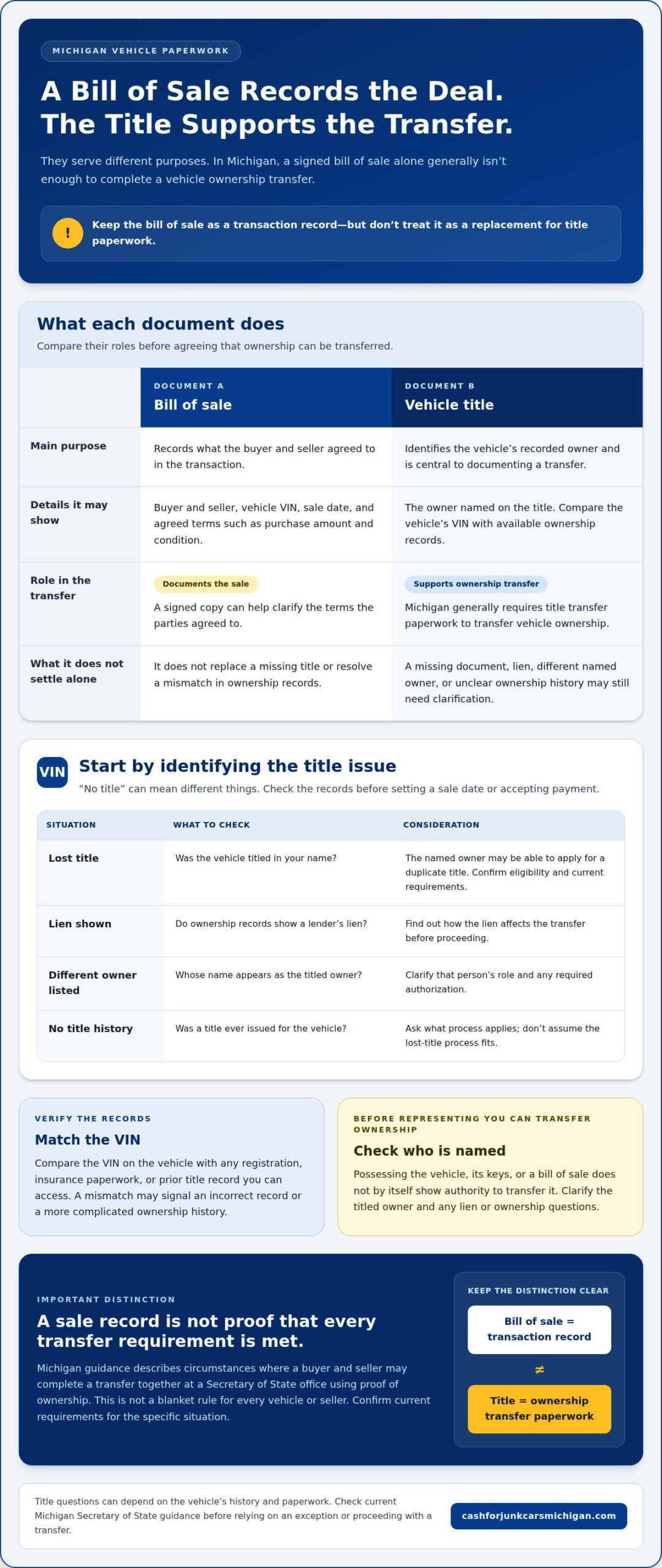
Usually, a bill of sale alone isn’t enough to complete a Michigan vehicle ownership transfer. It records what the buyer and seller agreed to, but it may not replace title paperwork required for the vehicle and circumstances. If you’re selling a car on a bill of sale only in MI, don’t assume that signing a receipt and handing over the keys finishes the transfer.
A vehicle title identifies its owner and supports an ownership transfer. A bill of sale serves a different purpose: it records details of the transaction. For general background on a title’s role, see Vehicle Title. Michigan requirements can depend on the vehicle’s history and paperwork, so check current guidance from the Michigan Secretary of State for your situation.
A bill of sale can document that a vehicle was sold, but it does not by itself establish that the seller can transfer ownership under Michigan’s title requirements.
What does a bill of sale prove?
A bill of sale creates a written record of the transaction. It commonly identifies the buyer and seller, describes the vehicle by its VIN, gives the sale date, and records agreed terms such as the purchase amount and condition. Both parties can keep a signed copy.
This record may help clarify what the parties agreed to if a disagreement arises. But it should not be treated as a replacement title. Even a detailed, signed bill of sale doesn’t resolve a missing title, a mismatch in ownership records, or another paperwork issue on its own.
Why does a Michigan vehicle title matter?
The title connects a vehicle to its recorded owner and is central to documenting a transfer. Before agreeing to a sale, check whose name appears on the title and whether the vehicle’s VIN matches the records. If the title is missing, names another person, or the ownership history is unclear, identify the issue before representing that you can transfer ownership.
There may be specific procedures or exceptions for some situations. For example, Michigan guidance describes circumstances where a buyer and seller may complete a transfer together at a Secretary of State office using proof of ownership. This isn’t a blanket rule for every vehicle or seller. Confirm current requirements with the Michigan Secretary of State before relying on an exception.
Start with the facts you can verify: who is listed as the owner, whether you have the title, and whether the vehicle information matches. Keep the bill of sale as a record of the agreed transaction, but don’t use it to fill gaps in the title history. The paperwork determines the next step, not the receipt alone.
What Changes When a Michigan Car Has No Title?
“No title” can describe several different problems. The document may simply be lost. It may never have been issued, a lender may still have a lien, or the title may name someone other than the person trying to sell the car. These situations aren’t interchangeable, so identify the issue before setting a sale date or accepting payment.
Lost title, lien, or ownership mismatch: identify the issue
Compare the seller’s identification and ownership records with the vehicle documents. Check that the VIN on the vehicle matches the VIN on any registration, insurance paperwork, or prior title record you can access. A mismatch may point to an incorrect record or a more complicated ownership history that needs official guidance.
Possessing the car doesn’t, by itself, show that you have authority to transfer it. If a lender’s lien appears in the records, the lien may affect what must happen before a transfer. If another person is listed as the titled owner, their role or authorization may matter. Don’t sign as the owner or promise a completed transfer based only on having the keys or a bill of sale.
Could a duplicate title solve the problem?
If the vehicle was titled in your name and the document was lost, applying for a duplicate title may be a practical route. It won’t necessarily address a lien, an ownership mismatch, or a title that was never issued. Confirm eligibility, application steps, and current requirements with the Michigan Secretary of State before relying on this option.
If the title names someone else, clarify the ownership records and that person’s role before moving forward. If the vehicle was never titled, don’t assume the lost-title process applies. Its history and paperwork may require a different path. Pause the transaction until you understand what documentation Michigan requires for the specific situation.
Use the VIN and available ownership records to describe the issue clearly when reviewing state instructions. The Michigan Title Transfer Requirements page is the official starting point for checking current transfer and registration guidance. Resolve title questions through current Michigan Secretary of State guidance before agreeing that a vehicle can be transferred. Doing so can help prevent a dispute over who had authority to sell or whether the buyer received the paperwork needed to complete the transaction.
- Lost title: Check whether the named owner can apply for a duplicate.
- Lien shown: Find out how the lien affects the transfer.
- Different owner listed: Clarify the owner’s role and any required authorization.
- No title history: Ask the state what process applies before making assumptions.
If title questions make a conventional sale difficult and the vehicle is unwanted, you can also request an offer for a junk car. Cash For Junk Cars Michigan buys vehicles without titles or keys. A buyer’s willingness to purchase doesn’t settle the state’s ownership or transfer requirements, so keep those questions separate as you decide what to do next.
Private Sale, Title Resolution, or Junk-Car Buyer: Compare Your Options
The right route depends on the vehicle’s paperwork, condition, and intended use. A private buyer may want clear ownership records before committing. Resolving a missing-title issue first can make that sale more straightforward. If the vehicle is unwanted, damaged, or no longer runs, a junk-car buyer is another option. None of these routes makes a bill of sale a substitute for Michigan’s required transfer steps.
| Option | Documentation to consider | Coordination and fit |
|---|---|---|
| Private sale | Title and ownership records, plus a bill of sale documenting the transaction | Buyer and seller coordinate the sale and required transfer steps. Best suited when ownership is clear and the vehicle is being sold for continued use. |
| Resolve title paperwork first | Available ownership records and any documents Michigan officials require for the situation | May take additional steps before a sale can proceed. Useful when the title is missing or the records need clarification. |
| Junk-car buyer | Available vehicle and ownership information; requirements depend on the circumstances | Can suit an unwanted, damaged, or non-running vehicle. A buyer’s willingness to purchase without a title doesn’t determine whether state transfer requirements are met. |
When is a private sale the practical route?
A private sale may make sense if you can document ownership and complete the transfer steps that apply to the vehicle. Consistent ownership information and a clear paper trail can help both parties understand the transaction. A bill of sale can record the date, vehicle, parties, and agreed terms, but don’t treat it as proof that the title transfer is complete by itself.
For additional general guidance on paperwork and the transaction process, see Autotrader’s Selling a Car in Michigan guide. Confirm current Michigan requirements through official state guidance before finalizing your sale.
When might a junk-car buyer fit better?
If the vehicle is wrecked, damaged, non-running, or difficult to sell privately, a junk-car buyer may be a more practical option. Cash For Junk Cars Michigan buys cars, trucks, and SUVs in varied conditions, including vehicles without titles or keys. That purchase doesn’t resolve questions about who owns the vehicle or what Michigan requires to document a transfer.
Separate the vehicle’s condition from its paperwork status. A car can be ready for removal while its ownership records still need attention. If you’re comparing options for an unwanted vehicle, the site’s guide to how to sell a junk car for cash and its overview of selling a car for parts address related considerations. Whatever route you choose, follow the transfer process that applies to your vehicle.
Before Selling a Car in Michigan With Limited Paperwork
Before agreeing to a sale, turn the paperwork question into a short fact-finding process. Identify the titled owner, gather the records you have, check for a lien, then verify the next step with current Michigan Secretary of State guidance. This is especially useful if you’re selling a car on a bill of sale only in MI. Separate what you know from what you’re assuming: having the vehicle or a signed receipt doesn’t automatically establish authority to transfer ownership.
Gather the vehicle and ownership information
Collect the details and documents that can help explain the vehicle’s history. Compare the VIN on the vehicle with the VIN on available records. Note whether the owner named in those records is you, someone else, or unclear. Don’t alter a document or fill in missing ownership details based on a guess.
- Vehicle details: VIN, make, model, and any other identifying information available.
- Ownership records: Current registration, prior title information, and any existing bill of sale or other records showing how you obtained the vehicle.
- Lien information: Any lender or lienholder details and lien-release paperwork you already have.
- Transaction records: Copies of messages about the sale and signed documents, including the bill of sale.
- Known gaps: Note whether the title is lost, names another owner, or has never been located. Don’t treat these situations as the same.
Keep copies together. A clear file makes it easier to explain the situation to a buyer and follow the right official instructions. If the title names another person or a lien appears in the records, clarify the issue before promising a transfer.
Verify the next step before handing over the vehicle
Use current Secretary of State guidance that fits the vehicle’s actual title situation. Look for instructions on a missing title, ownership differences, liens, or any applicable exception. A process that works in one circumstance may not apply to another, so don’t rely on a general online discussion or assume a bill of sale settles the question.
Before signing, read every document and make sure its details are accurate. Don’t sign incomplete paperwork or claim ownership rights you can’t establish. Record what you know, what remains uncertain, and what the state’s instructions say to do next. If removal is being arranged for an unwanted vehicle, keep the paperwork question separate from the vehicle’s condition. Cash For Junk Cars Michigan buys vehicles in varied conditions, including vehicles without titles or keys, but that does not replace Michigan’s transfer requirements.
Verify current Michigan requirements for your vehicle’s title situation before signing transfer documents or handing over the car.
For a vehicle headed for disposal, the article How to Scrap a Car for Cash: A Simple 5-Step Guide covers practical steps for scrapping a car. If you’re ready to move forward with an unwanted vehicle, request an offer for your car.
Selling an Unwanted Michigan Car Without a Title: A Practical Next Step
A missing title can make a private sale harder, especially if the vehicle is damaged, wrecked, or no longer runs. If you’re considering selling a car on a bill of sale only in MI, keep two questions separate: whether a buyer is willing to purchase the vehicle and what Michigan requires to document its ownership and transfer. A bill of sale or a buyer’s offer doesn’t settle the state’s paperwork requirements.
Cash For Junk Cars Michigan buys cars, trucks, and SUVs in varied conditions, including vehicles without titles or keys. For vehicles the company purchases, the offer includes cash and free towing. Same-day pickup is the company’s aim across Michigan, not a guaranteed appointment.
What can the seller expect from the junk-car option?
This option may fit an unwanted vehicle that’s damaged, wrecked, non-running, or difficult to sell privately. Free towing means you don’t need to arrange separate transport for a vehicle the company purchases. Share the vehicle’s condition and paperwork situation accurately when discussing an offer. A purchase without a title doesn’t establish that a transfer meets Michigan requirements.
Keep available ownership documents and transaction records together. If you’re unsure who is listed as the titled owner, a lien is involved, or the vehicle’s history is unclear, treat that as a separate paperwork question. Verify the applicable state process before representing that you can transfer ownership or handing over documents.
How to take the next step
Have basic details ready, such as the vehicle’s make, model, condition, VIN if available, and the paperwork you have. Explain whether the title is lost, names another owner, or is affected by a lien. Accurate information helps the company consider the vehicle and discuss an offer without confusing willingness to buy with legal transfer requirements.
Before pickup, review the transaction documents and keep copies of signed records. Don’t assume the bill of sale alone completes the state’s ownership process. If you still need to resolve title questions, check current Michigan Secretary of State guidance for your specific circumstances.
For a damaged or unwanted car, truck, or SUV, request an offer and arrange free towing for a vehicle the company purchases. Request a cash offer and arrange pickup.
Choose the Next Step That Clears the Way
A paperwork problem doesn’t have to leave an unwanted vehicle sitting unused. Decide whether your next move is to resolve the title issue or explore a sale option that fits the vehicle’s condition. Keep ownership questions separate from removal plans, and don’t rely on a bill of sale alone to establish that a transfer is complete.
If selling a car on a bill of sale only in MI has stalled your plans, consider a practical route for a vehicle you no longer want. Cash For Junk Cars Michigan buys cars, trucks, and SUVs in varied conditions across Michigan. Free towing is included for vehicles the company purchases, making removal simpler to arrange.
Share accurate details about the vehicle and your paperwork when requesting an offer. Then follow the steps that apply to your ownership situation before completing the transfer. Request a cash offer for your unwanted car and take the next step toward clearing it from your property.
Frequently Asked Questions
Can I sell a car in Michigan with only a bill of sale?
A bill of sale can record the terms of a deal, but don’t assume it replaces a title required for the vehicle’s transfer. When selling a car on a bill of sale only in MI, the specific process may depend on the vehicle and your circumstances. Agreeing on a sale and completing a state-recognized ownership transfer are separate steps. Check current Michigan Secretary of State guidance before accepting payment or handing over the vehicle.
Does a bill of sale prove ownership of a car in Michigan?
A bill of sale can show that a buyer and seller agreed to a transaction, including the vehicle details and sale date. It doesn’t automatically prove that the seller has authority to transfer ownership or replace title documents when required. For example, a receipt from a prior purchase may not resolve a mismatch between the seller’s name and available vehicle records. Compare your documents and verify your situation through current Michigan guidance.
Can I get a duplicate Michigan title if I lost the original?
A duplicate-title request may be an option if you’re entitled to the title and the original was lost. Eligibility and next steps can depend on the vehicle’s record and circumstances, so don’t assume an application will resolve a lien or an ownership mismatch. Review current Michigan Secretary of State instructions for application requirements and any conditions that apply before arranging a sale around an expected replacement title.
Can I sell a car in Michigan if there is still a lien on it?
A lien can affect the sale and the paperwork needed to transfer ownership. Identify the lienholder and find out what payoff, release, or title steps apply before committing to a transaction. For example, a seller may need to coordinate with a lender rather than treat a buyer’s payment as proof that the lien is cleared. Procedures can vary, so consult current Michigan Secretary of State guidance for your situation.
Can a junk-car buyer buy my car without a title in Michigan?
Cash For Junk Cars Michigan buys vehicles without titles. That doesn’t automatically resolve ownership questions or Michigan transfer requirements. Share accurate details about who owns the vehicle and what paperwork you have. The company buys cars, trucks, and SUVs in varied conditions, including damaged or non-running vehicles, and provides free towing for vehicles it purchases. A purchase offer and the state’s ownership documentation process are separate matters.
What should I do before selling a car with no title in Michigan?
First, identify the titled owner and gather the VIN, registration, prior title information, and other ownership records you have. Check whether a lien appears in the records, then review current Michigan Secretary of State instructions for your circumstances. Keep copies of messages and documents, and note any gaps or mismatched details. Don’t assume a bill of sale alone completes the transfer. Then compare resolving the paperwork with selling an unwanted vehicle.
Is a bill of sale enough to register a car in Michigan?
Not necessarily. Registering a vehicle and documenting its ownership transfer are related processes, but a bill of sale should not be assumed to replace title documents required for either step. Requirements may depend on the vehicle’s record and the transaction. Before attempting registration, review current Michigan Secretary of State instructions for your circumstances, including what ownership documents are needed. If the VIN or owner information doesn’t match, resolve that discrepancy before proceeding.