

Handing over your keys without the right paperwork doesn’t just lose you money. It can leave you legally responsible for a car you no longer own. You want that eyesore off your driveway immediately, but the fear of being lowballed or stuck with Secretary of State fines is a real concern. This selling a car to a junkyard checklist helps you avoid these traps while ensuring you get the best possible price for your vehicle. It’s frustrating to deal with confusing title laws or the threat of paying over $100 for a local tow on a car that doesn’t even run.
We know you need a fast, profitable solution without the typical runaround. We promise that following these steps will lead to a legal, high-paying, and hassle-free sale of your junk vehicle. You’ll learn how to navigate the 2026 Michigan salvage and scrap title regulations, including the mandatory Form TR-12 requirements updated by House Bill 5234. We’ll show you how to secure free vehicle removal and ensure your liability ends the moment the tow truck pulls away. It’s time to turn that junk into immediate liquidity without the stress.
Key Takeaways
- Clean out all personal belongings and remove your license plates to prepare for the mandatory Secretary of State return.
- Follow this selling a car to a junkyard checklist to navigate 2026 Michigan title laws and ensure all active liens are cleared before the sale.
- Gather your VIN and mileage details to secure a high-paying quote based on real-time scrap metal market values.
- Ensure your vehicle is accessible for a standard tow truck to guarantee a fast inspection and free removal from your property.
- Protect yourself from future liability by notifying the Michigan SOS of the transfer and canceling your insurance policy immediately.
Pre-Sale Preparation: Cleaning Out and Assessing Your Vehicle
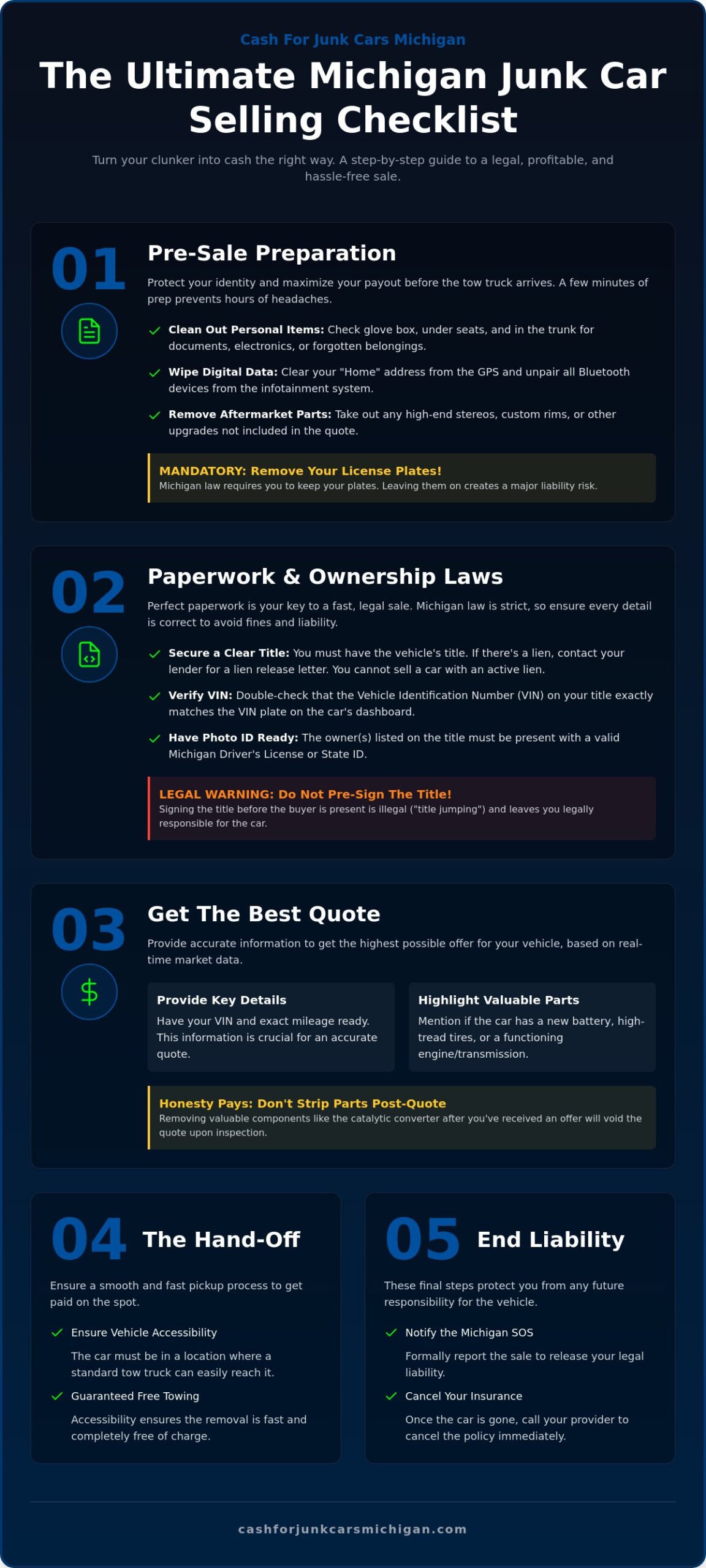
Preparation is the difference between a fast payday and a long afternoon of frustration. Before you call for a pickup, you must get the car ready for its final trip. This isn’t just about tidying up; it’s about protecting your identity and maximizing your payout. Starting your selling a car to a junkyard checklist with a thorough inspection ensures you don’t leave money or sensitive info behind. Don’t rush this stage. A few minutes of prep prevents hours of legal or financial headaches later.
First, evaluate the mechanical condition of the vehicle. If the car still runs or has valuable components like a new battery or high-tread tires, mention this during the quote process. You also need to decide if you’re selling the car as a complete unit or parting it out. While selling individual parts can sometimes net more cash, it’s a slow process that requires mechanical skill and storage space. Most Michigan owners prefer the speed of selling the entire vehicle to a professional wrecking yard for immediate removal and cash. If you choose to sell it whole, don’t strip essential parts like the catalytic converter or engine components after receiving a quote, as this will void your offer.
The Personal Property Sweep
You’d be surprised what people leave in junk cars. Check the hidden spots that are easy to overlook. Flip down the sun visors to check for old insurance cards. Pull up the trunk liners and look in the well under the spare tire. These areas often hide paperwork that contains your home address or social security number. If your car has a modern infotainment system, you must clear your digital footprint. Delete your saved “Home” location from the GPS and unpair all Bluetooth devices. If you have expensive aftermarket gear like a high-end stereo or custom rims, remove them now. Unless these upgrades were specifically factored into your quote, you’re better off keeping them or selling them separately.
License Plates and Insurance Prep
Michigan law requires you to keep your license plates. Never let a tow truck driver leave with your plates still attached to the vehicle. You’ll need to return them to the Secretary of State or transfer them to your next car. Leaving them on the vehicle creates a liability risk if the car is involved in an incident before it’s processed. Keep your current registration in your pocket during the hand-off; it acts as a secondary proof of ownership if there’s a question about the title. Finally, have your insurance company’s contact info ready. You shouldn’t cancel the policy until the car is physically removed from your property, but you want to be ready to make that call the second the truck pulls away.
Documentation Checklist: Michigan Title and Ownership Laws
Michigan law doesn’t leave room for error when it comes to vehicle ownership. If the paperwork isn’t perfect, you’re still liable for the car. This part of the selling a car to a junkyard checklist focuses on the legal requirements you must meet before the tow truck arrives. You need to prove you have the legal right to sell the asset to avoid future legal disputes or SOS fines. Don’t assume the buyer will handle the legalities for you. It’s your responsibility to ensure the transfer is documented correctly with the state.
Handling Liens and Clear Titles
A clear title is your ticket to a fast payout. If you recently finished paying off a loan, contact your lender immediately for a lien release. You cannot sell a car with an active lien to a professional buyer. Always verify that the VIN on your title matches the VIN plate on your dashboard exactly. Even a single digit error can halt the transaction. According to J.D. Power’s guide to junking a car, having your documentation organized is the fastest way to ensure a smooth hand-off. Do not sign the title until the buyer is physically present. Signing early can lead to “title jumping,” which is illegal in Michigan and leaves you responsible for any future tickets or accidents.
The owner listed on the title must be present for the sale. If there are two names on the title joined by “and,” both individuals must sign. If they are joined by “or,” either person can complete the transaction. Ensure you have a valid Michigan driver’s license or state-issued photo ID ready for verification. The buyer needs this to record the transaction and protect themselves from purchasing stolen property.
Selling a Junk Car Without a Title in Michigan
Missing paperwork is a common headache, but it doesn’t always mean you’re stuck with the car. For older vehicles, the Michigan Secretary of State provides specific pathways for transfer. You might need to use Form TR-205 for self-certification of ownership if the vehicle is over 10 years old. If you’ve lost your documentation, Cash For Junk Cars Michigan can help you navigate the necessary SOS requirements to finalize the sale legally. While some buyers might accept a registration as alternative proof, a valid title is always the safest route. Don’t let a missing piece of paper stop you from getting paid; just ensure you’re following the state-mandated steps to end your liability correctly.
Getting the Quote: How to Maximize Your Junk Car Payout
You want the most money possible for your vehicle. Achieving that requires more than just making a phone call; it requires data. Add “gathering vehicle specs” to your selling a car to a junkyard checklist right now. You need the 17-digit VIN, an accurate odometer reading, and a detailed list of any missing parts. If the engine is gone or the catalytic converter was stolen, you must disclose it immediately. Professional buyers will spot missing components during the physical inspection, and your quote will drop the moment they arrive. Providing accurate details upfront protects your price and ensures the transaction moves quickly without frustrating renegotiations.
Factors That Determine Junk Car Value
Your car’s value isn’t arbitrary. It’s based on weight and the demand for salvaged components. Heavier vehicles like SUVs and trucks typically command higher prices than compact sedans because they contain more recyclable steel. Beyond raw metal, specific parts like functional engines, transmissions, and catalytic converters drive up the offer significantly. Scrap metal prices in Michigan change daily based on global market demand and shipping costs. If steel prices are up, your car is worth more. If they’re down, your offer will reflect that reality. Don’t wait weeks to decide on a quote. The market moves fast, and a high offer today might disappear by tomorrow morning.
Comparing Local Michigan Offers
Don’t just look at the dollar amount on the screen. Traditional scrapyards might require you to drive the car to them, while modern “Instant Quote” services provide a price over the phone or online. Always ask specifically if the quote includes free towing from your location. Many yards will offer a high price but then deduct a $100 towing fee at the curb. This is a common “bait and switch” tactic that leaves you with less cash than you planned for. Check scrap car prices to see if the offer you received aligns with current Michigan market trends. A fair, professional buyer will be transparent about their pricing structure and won’t hide fees.
Always verify that you’re dealing with a licensed Michigan auto recycler. Unlicensed “middlemen” often provide higher initial quotes to get you on the hook, only to lower the price once they arrive. They lack the overhead of a real facility but also lack the legal protections you need for a safe transfer. Stick with established businesses that offer immediate payment and complimentary logistical support. This ensures your transaction is fast, legal, and final. To see how professional services maintain visibility on top classified networks, you can explore Premium Listing and Featured Advertising Fees to learn about the marketplace options available to reputable companies. If a buyer hesitates to give you a firm, guaranteed price over the phone based on your accurate description, move on to a more reliable service provider. Your time is too valuable to waste on lowballers.
The Hand-Off: Towing Logistics and Getting Paid
The arrival of the tow truck is the most critical step in your selling a car to a junkyard checklist. You must be present and ready to move fast. Schedule a pickup time that allows for at least a 20-minute inspection. This window gives the driver enough time to verify the vehicle’s condition against your initial description. They will check for the engine, transmission, and especially the catalytic converter. If everything matches your quote, the process stays simple and transactional. Don’t let the driver rush you through the paperwork before you’ve seen the money.
Accessibility is a major factor in a successful hand-off. A standard tow truck needs enough room to maneuver and hook up the vehicle safely. If your car is blocked by other vehicles or parked in a tight spot, clear those obstacles before the driver arrives. In Michigan, a local tow typically costs between $75 and $145. Choosing a buyer that provides free removal saves you this significant expense. However, if the extraction is unusually difficult, some companies may try to add fees. Avoid this by having the car ready for a straight pull. If the car is in a garage, push it into the driveway beforehand.
Preparing for Free Towing
Clear a path to the vehicle to avoid “difficult extraction” fees. Confirm the driver is from a reputable junk car removal service when they arrive. Stay with the vehicle until the exchange is complete. Never leave the keys in the car for a driver to pick up later. You need to be there to sign the title and receive your payment in person. If the car is on a busy street, ensure there is enough space for the tow truck to park without blocking traffic during the load-up.
Finalizing the Transaction
Review the bill of sale or receipt for total accuracy. It must list the VIN, the date of sale, and the final price paid. This document is your proof that you no longer own the vehicle. Accept only cash on the spot. Checks are unreliable and can lead to cashing issues or fraud. Hand over the keys only after the cash is in your hand. Once the money is verified, sign the title and watch the driver load the vehicle. This immediate exchange of cash for the asset is the only way to guarantee a safe sale. If you want a guaranteed payout without the hassle, get your cash offer now.
Post-Sale Checklist: Ending Your Liability in Michigan
The tow truck is gone and you have the cash in your hand. While the physical transaction is over, your legal responsibilities continue until you notify the state. Skipping the final steps of your selling a car to a junkyard checklist can lead to expensive surprises months down the road. If the buyer doesn’t process the title correctly, Michigan still sees you as the owner. This means you are responsible for any future parking tickets, abandoned vehicle fees, or liability claims. You must act fast to sever all ties and protect your bank account from an unnecessary drain.
Notifying the Michigan Secretary of State
Report the sale to the Michigan Secretary of State (SOS) immediately. You can do this by visiting a local branch in person or by using the convenient SOS online portal. This step is non-negotiable for anyone wanting a clean break from their junk vehicle. Reporting the transfer is the only way to ensure that your name is removed from the active registration database. If the car is ever towed to an impound lot after the sale, the lot will look for the last registered owner to pay the storage fees. Michigan law requires sellers to maintain proof of sale for liability protection. By documenting the transfer with the SOS, you create a legal shield that prevents these costs from falling on you.
Final Administrative Tasks
Call your insurance agent and remove the junker from your policy today. Most companies will provide a pro-rated refund if you’ve already paid for the month. Do not leave the car on your policy. Once the title is signed and the car is removed, your coverage is no longer your concern. Take a moment to check for any remaining toll tags or local parking permits. These are often tied to your credit card or bank account. If you leave them in the car, you might find yourself paying for the tow truck’s tolls or the junkyard’s logistical movements. Remove them and cancel the associated accounts or transfer them to your new vehicle.
Handle your old license plates with care. Michigan plates stay with the owner, not the car. You should either destroy the plate or take it to the SOS to transfer it to a different vehicle. Finally, keep your copy of the bill of sale for at least three years. This document is your definitive proof of the transaction date and the buyer’s identity. If you found this process efficient, you can learn more about the sell my junk car process to help others in your circle get rid of their unwanted vehicles for top dollar. Follow these steps to ensure your sold status is permanent and legally recognized.
Get Cash for Your Michigan Junk Car Today
You now have the complete selling a car to a junkyard checklist to manage your transaction with total confidence. By following these steps, you’ve learned how to protect your identity, navigate Michigan title laws, and maximize your financial return. Clearing out your personal belongings and removing your license plates are small tasks that prevent major legal headaches later. Don’t let a rusted or broken vehicle sit on your property and lose value every day. It’s time to turn that unwanted asset into immediate liquidity without any unnecessary fuss.
We specialize in fast, no-nonsense transactions that put money in your pocket immediately. We provide cash paid on the spot for cars, trucks, and SUVs in any condition. You don’t have to worry about logistics because free towing is included with every single purchase. We even offer same-day pickup available across Michigan to fit your busy schedule. Get an instant cash offer for your junk car in Michigan now! It’s the easiest way to end your liability and walk away with the money you deserve. Your driveway will be clear before you know it.
Frequently Asked Questions
Do I need a title to sell my car to a junkyard in Michigan?
Yes, you generally need a valid title to sell a vehicle to a junkyard in Michigan. The state has strict regulations to prevent theft and ensure a clear chain of ownership. If your car is over 10 years old and the title is missing, you may be able to use Form TR-205 for self-certification. Always include title verification on your selling a car to a junkyard checklist to avoid delays during the hand-off.
How much do junkyards in Michigan typically pay for a scrap car?
Payouts depend on the vehicle’s weight and the current market price for scrap steel. As of July 2026, Michigan scrap prices average approximately $175 per ton. This means a complete vehicle could net between $300 and $500 or more during periods of high demand. Factors like functional engines or intact catalytic converters will increase your final offer. We provide instant quotes based on these real-time market fluctuations.
Should I remove parts from my car before selling it to a junkyard?
You should only remove parts if you specifically excluded them when getting your initial quote. Removing valuable components like the catalytic converter or battery after receiving an offer will cause the buyer to lower the price at the curb. If you plan to part out the vehicle, do it before calling for a pickup. Most owners find it faster and more profitable to sell the car as a complete unit.
What happens if I sell my junk car and don’t notify the SOS?
You remain legally liable for the vehicle until the Michigan Secretary of State records the transfer. If the car is involved in an accident or abandoned after the sale, you will receive the tickets and impound fees. Reporting the sale through the SOS online portal or at a branch is the only way to stop these liabilities. Keep your bill of sale as proof that the transaction occurred on a specific date.
Can I sell a junk car that has a lien on it?
No, you cannot sell a junk car in Michigan if there is an active lien on the title. You must pay off the remaining balance and obtain a lien release from your lender first. Once the lien is cleared, the title is considered clean and ready for transfer. Professional buyers require a clear title to ensure they are purchasing the asset legally from the rightful owner. Don’t waste time calling for a quote until the lien is removed.
Does the car need to be in running condition for a junkyard to buy it?
No, the vehicle does not need to run for us to buy it. We purchase cars, trucks, and SUVs in any condition, including those with blown engines or total body damage. While a running car might command a higher price for its parts, a non-running vehicle still has significant value in its recyclable metal. We handle the logistics and removal regardless of the car’s mechanical state. Our goal is to provide immediate liquidity for your problematic asset.
How do I avoid scams when selling my car to a junkyard?
Stick to licensed Michigan auto recyclers who offer guaranteed quotes and cash on the spot. Avoid middlemen who change the price once they arrive at your property. A reputable buyer will provide a professional bill of sale and won’t charge hidden towing fees. Including verify the buyer’s license on your selling a car to a junkyard checklist is the best way to ensure a safe, transactional experience. If the deal feels suspicious, walk away.
Is towing always free when selling a junk car in Michigan?
Free towing is not a legal requirement, but we include it with every purchase to make the process hassle-free. Some yards may deduct a towing fee from your final payout, which can cost between $75 and $145 in Michigan. Always confirm that your quote is all-inclusive before scheduling a pickup. We prioritize speed and efficiency by providing complimentary removal services for every junk vehicle we buy. You should never pay out of pocket for towing a car you are selling for scrap.