

In Michigan, your vehicle is legally considered a total loss the moment repair costs hit 75% of its pre-accident value. Knowing exactly what to do with a car after an accident is the difference between a massive financial loss and a fast recovery. You’re likely dealing with aggressive insurance adjusters and rising storage fees while wondering if your car is even worth fixing. It’s a stressful situation that demands immediate action.
Paperwork shouldn’t stand in your way. We help you navigate common Michigan hurdles, including missing titles or lost keys. If you need to retrieve items from a locked wreck, you can discover more about Vehicle Lockout Service from Allways Towing to regain access. If your vehicle is stuck at a body shop or a high-fee impound lot, we handle the logistics. Our service includes Free Junk Car Removal, so you never pay to move a car that isn’t worth fixing. We provide Cash for Junk Cars and Cash for Junk Trucks & SUVs on the spot. You get the money you need to put toward a safer vehicle immediately. There is no sentimentality here. It’s a practical exchange designed to save you time and money.
We understand that you want this problem solved quickly without the burden of high towing costs or lowball offers. This 2026 recovery guide provides the roadmap you need to handle your insurance claim successfully and walk away with the maximum cash payout for your wrecked vehicle. We’ll explain how to meet the one-year PIP benefit deadline, how to file a $3,000 mini-tort claim for vehicle damage, and how to secure free junk car removal. You’ll learn how to turn your damaged car, truck, or SUV into immediate liquidity and move on with your life.
Key Takeaways
- Prioritize physical safety and secure an official police report to protect your future insurance and legal claims.
- Learn exactly what to do with a car after an accident to navigate Michigan adjusters and secure a fair appraisal.
- Identify the critical damage thresholds that signal a total loss and why repair is often a poor financial decision.
- Avoid the risks of private sales and low dealership trade-in offers by choosing a direct cash payout for your wreckage.
- Discover how to secure immediate cash for junk cars or trucks including complimentary removal and help with missing titles.
Immediate Steps: What to Do at the Accident Scene
The seconds following a crash are critical. Your priority is safety and legal protection. Check yourself and your passengers for injuries immediately. If the vehicle is in a dangerous spot and can still move, get it to the shoulder. Michigan “Steer It, Clear It” principles require you to move vehicles from the roadway to prevent further incidents. This keeps traffic flowing and reduces the risk of secondary crashes. Stop the car, turn off the engine, and activate your hazard lights.
Knowing what to do with a car after an accident begins with involving the authorities. Contact 911 if anyone is hurt or if the damage is significant. In Michigan, you must file a report if the accident results in injury, death, or property damage over $1,000. An official police report is a non-negotiable requirement for your insurance carrier. It serves as the primary record for your Personal Injury Protection (PIP) benefits and any future mini-tort claims. Don’t leave the scene until the officer clears you to go.
Safety and Legal Compliance in Michigan
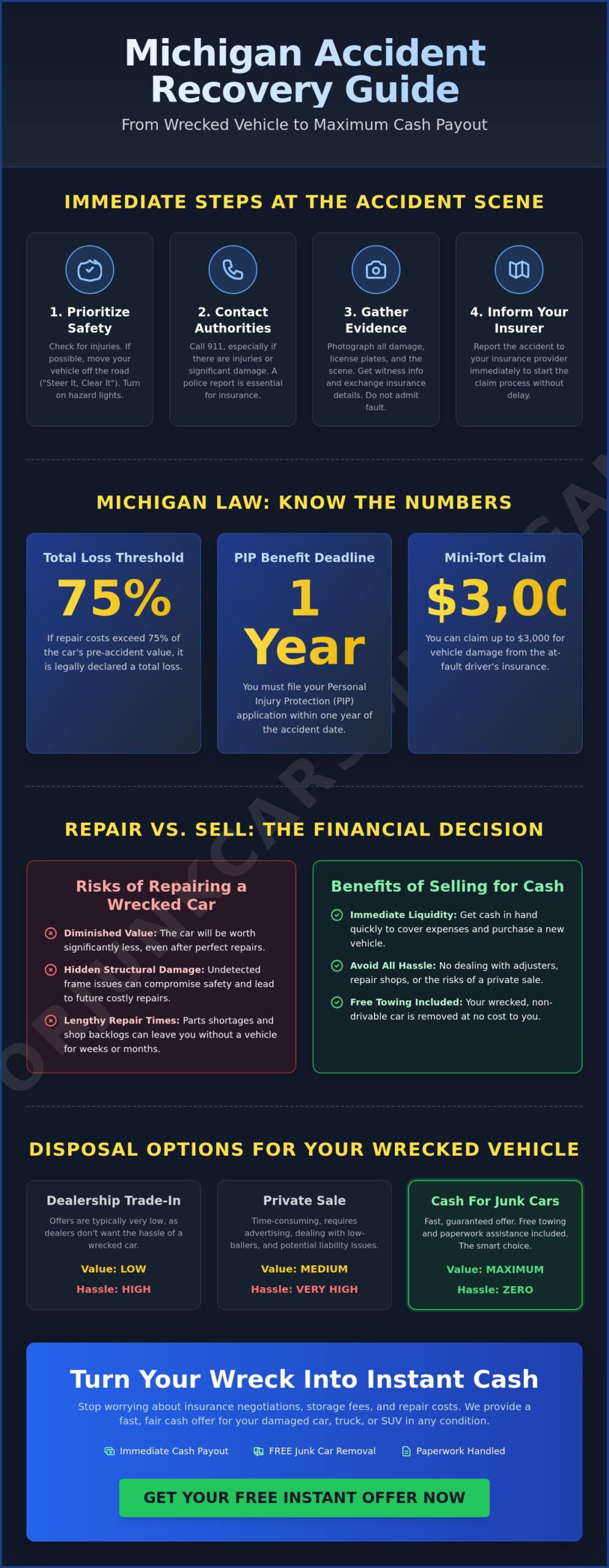
Michigan operates under a no-fault insurance system. This means your own insurance pays for your medical bills regardless of who caused the wreck. You must file your PIP application within one year of the accident date. Don’t wait. If the scene is safe and damage is minor, dispatch might direct you to file a report at the nearest station later. However, always call 911 first to let the professionals make that call. Secure the scene and never admit fault to the other driver or the police. Stick to the facts of the event.
Evidence Collection for Maximum Recovery
Your vehicle’s remains have value, but you must prove its condition. Take high-resolution photos of all damage, license plates, and the surrounding environment. A deeper look into understanding traffic collisions shows that scene evidence disappears quickly. Photograph the engine bay and interior to show the car was well-maintained before the impact. This documentation helps when adjusters try to lowball your car’s actual cash value or pre-accident condition.
Collect witness contact information and insurance details from the other driver. Get names, phone numbers, and policy numbers. If witnesses are present, ask them to stay until police arrive or record a quick statement on your phone. This data protects your liability and ensures you have the leverage needed for a successful insurance claim. Clear evidence makes the transition to getting cash for your car much faster once the legal dust settles.
Navigating the Insurance Claim and Appraisal Process
Call your insurance provider immediately once you’re safe. Delaying the claim gives adjusters a reason to question the timeline. The adjuster’s primary job is to protect the company’s bottom line. They’ll evaluate the wreck to determine if it’s repairable or a total loss. In Michigan, the magic number is 75%. If repairs cost 75% or more of the car’s actual cash value, it’s legally totaled under Michigan Compiled Law 257.217c. Knowing what to do with a car after an accident means being ready for that “Total Loss” phone call before it happens.
Don’t accept the first check they offer. These initial numbers are often low estimates based on generic data. You need to do your own research. If you find the insurance process too slow or the offers too low, you can always choose to get cash for junk cars directly from a buyer who values the vehicle’s remains. This is often the fastest way to put cash in your pocket and move on.
The Adjuster Visit: What They Look For
Adjusters calculate Actual Cash Value (ACV) by looking at mileage, condition, and local market demand. They often use software that ignores recent upgrades. Show them receipts for new tires, recent engine work, or major brake repairs performed within the last few months. These can bump up your valuation. Always insist on a physical inspection. Photo-based estimates often miss structural damage hidden behind bumpers or under the frame. A physical look ensures every bit of damage is documented.
Disputing a Low Settlement Offer
If the offer feels low, prove it. Find at least three “comparables” for sale in your part of Michigan. These should be the same year, make, model, and trim level. If you can’t agree, you have the right to an independent appraisal. You can also negotiate to keep the car by accepting a lower payout minus the “salvage value.” This is helpful if you plan to sell the wreckage yourself. Remember that under Michigan law, you can also pursue a mini-tort claim for up to $3,000 for vehicle damage not covered by your own insurance if the other driver was at fault.
Repair vs. Total Loss: Making the Financial Decision
Fixing a wrecked vehicle is often a gamble you’ll lose. In Michigan, insurers use a 75% threshold to declare a total loss. If the estimated repairs meet or exceed 75% of the car’s pre-accident value, Michigan Compiled Law 257.217c requires a salvage title. You must calculate the math carefully when deciding what to do with a car after an accident. Compare the cost of your deductible and rising parts prices against the current scrap car prices. As of April 2026, Michigan scrap cars average around $170 per ton. Sometimes, the cash from the wreckage is worth more than the headache of a repair.
Safety is the biggest concern. Modern vehicles have complex crumple zones. Once the frame is compromised, the car’s structural integrity is gone. A repaired frame might look straight, but it won’t protect you the same way in a second collision. You also face “Diminished Value.” Even if a shop fixes the car perfectly, its history report will show a major accident. This record permanently lowers the resale value by thousands of dollars. You’re paying to fix a car that you won’t be able to sell for a fair price later.
Hidden Costs of Repairing a Wreck
The initial estimate is rarely the final bill. Body shops often find “supplemental” damage once they tear the car down. This can add weeks to the timeline and thousands to the cost. Michigan body shops currently face backlogs due to parts shortages. You might spend a month or more paying for a rental car while waiting. A salvage title also makes the car harder to insure. Many carriers will only offer liability coverage on a previously totaled vehicle. This leaves you unprotected in the future.
The Financial Benefits of Walking Away
Walking away is often the most profitable move. Take the insurance settlement and sell the remaining shell for cash. This strategy gives you immediate liquidity. You avoid the “zombie” car experience where the alignment is never quite right or electronic sensors keep failing. Combine your insurance check with the cash from your wreckage to upgrade to a safer, more reliable vehicle. It’s a clean break that saves you from months of mechanical frustration and financial drain. This path is the fastest way to get back on the road without the baggage of an accident history.
Disposal Options for Your Wrecked Vehicle
Deciding what to do with a car after an accident is often more stressful than the crash itself. You have a few options, but most of them waste your time. Selling to a private buyer is nearly impossible for a wrecked vehicle. Most people want a car they can drive tomorrow. They don’t want a vehicle with a salvage history or structural damage. You’ll waste days answering questions and dealing with people who never show up. It’s a high-stress route with very little reward.
Trading in your damaged car at a traditional dealership is another dead end. Dealers want inventory they can sell quickly. They’ll offer you a fraction of the car’s actual value because they plan to send it straight to an auction. You’re better off keeping the car and selling the remains yourself. If you want a fast, guaranteed payout, you need a transactional solution that values the vehicle for its metal and components. You can get cash for junk cars right now and avoid the dealership games entirely.
The Reality of Selling Car for Parts
Many owners think stripping the car themselves is the best way to make money. This is rarely true. Most Michigan Homeowners Associations (HOAs) have strict rules against keeping non-running vehicles in driveways or yards. You’ll need a garage, professional tools, and significant mechanical knowledge. Listing individual parts on secondary markets takes months. You have to clean, photograph, and ship every item. Once the “good parts” like the engine or catalytic converter are gone, you’re still stuck with 3,000 pounds of heavy steel. You’ll still need a way to transport the shell to a recycler.
Why Junking is the Default Choice for Junk Cars
Professional junk car removal is the fastest way to stop the financial bleed. Body shops and impound lots charge daily storage fees that eat into your insurance settlement. Junking the car removes that liability immediately. Professional buyers handle the heavy lifting and environmental disposal. They drain hazardous fluids like oil, coolant, and brake fluid according to Michigan regulations. It’s a simple, one-and-done transaction. You get paid, the car is gone, and you don’t have to worry about the logistics. It’s the most efficient way to turn a problematic asset into immediate liquidity.
The Fastest Way to Get Cash for an Accident Car in Michigan
Stop waiting for insurance checks that don’t cover your mounting storage fees. If you are struggling with what to do with a car after an accident, the answer is simple. Turn that wreckage into immediate liquidity. Cash For Junk Cars Michigan provides a definitive, no-hassle solution for owners of unwanted assets. We buy vehicles in any condition; whether they are smashed, non-running, or legally totaled. We focus on speed and efficiency above all else. You don’t have to deal with the administrative nightmare of private buyers or the lowball offers of traditional dealerships.
Paperwork shouldn’t stand in your way. We help you navigate common Michigan hurdles, including missing titles or lost keys. If your vehicle is stuck at a body shop or a high-fee impound lot, we handle the logistics. Our service includes Free Junk Car Removal, so you never pay to move a car that isn’t worth fixing. We provide Cash for Junk Cars and Cash for Junk Trucks & SUVs on the spot. You get the money you need to put toward a safer vehicle immediately. There is no sentimentality here. It’s a practical exchange designed to save you time and money.
Our Michigan-Wide Service Area
Our network covers the entire state. We offer rapid service from Detroit and Wayne County to Grand Rapids and all surrounding areas. If your car is sitting in a yard in Lansing or a shop in Flint, we can reach you. We specialize in working with local Michigan impound lots to facilitate the release of your vehicle. This prevents daily storage fees from eating your entire payout. Same-day pickup is often available for urgent removals. Tell us where the wreck is located, and we’ll handle the rest.
How to Sell My Junk Car in 3 Steps
We’ve simplified the recovery process into three direct actions. Follow this path to clear your property and fill your wallet:
- Call or Text: Provide the year, make, model, and accident details. Be honest about the condition so we can give an accurate estimate.
- Get Your Quote: Receive an instant, no-obligation offer based on current market rates for scrap and components.
- Schedule Pickup: We arrive at your location, verify the vehicle, and hand you cash. We tow the wreck away for free.
This is the most efficient way to resolve the question of what to do with a car after an accident. You get rid of a problematic item and walk away with immediate financial gain. Contact us now to get your quote and schedule your removal.
Take Control of Your Recovery Today
Recovering from a collision requires fast decisions and clear information. You now know how to navigate Michigan’s 75% total loss threshold and why repairing a compromised frame is a losing financial gamble. Identifying the right way to handle what to do with a car after an accident saves you from mounting storage fees and low insurance settlements. Stop letting a wrecked vehicle drain your bank account and clutter your property. It’s time to turn that liability into immediate liquidity.
We provide the fastest exit strategy in Michigan. Our service includes free towing from any home, shop, or impound lot. We pay cash on the spot regardless of the vehicle’s condition or paperwork status. Same-day service is available in most areas to ensure you get paid without delay. Don’t wait for another bill to arrive. Get an Instant Cash Offer for Your Wrecked Car Now and put this accident behind you. You have the tools to move forward with confidence.
Frequently Asked Questions
Can I sell my car after an accident if I don’t have the title?
Yes, you can sell your vehicle even if the title is missing. We help Michigan owners navigate the paperwork hurdles required to prove ownership through registration and identification. Our team handles the administrative barriers that often stop other buyers. Don’t let a lost document prevent you from getting a fast payout. We specialize in making the transaction simple and efficient regardless of your paperwork status.
Who is responsible for towing fees after a car accident in Michigan?
The vehicle owner is typically responsible for initial towing and storage fees unless covered by specific insurance policies. These costs accumulate daily at impound lots and body shops. To stop these expenses, we provide complimentary removal services for every vehicle we purchase. We pick up the wreck directly from the lot or shop. This ensures you keep your full cash payout without losing money to logistical fees.
Is it better to repair my car or sell it for scrap after a wreck?
Selling for scrap is usually the smarter financial move if the car has structural damage or high repair costs. Repaired vehicles suffer from permanent diminished value and may never drive safely again. If you are deciding what to do with a car after an accident, choosing immediate liquidity is often better than waiting weeks for a backlogged shop. You get cash now to put toward a newer, safer vehicle.
How much cash can I get for a totaled car?
Your payout depends on the vehicle’s year, make, model, and overall weight. We evaluate the remaining value of the components and the raw metal to give you a fair, competitive offer. While market rates for metal change, we provide instant quotes based on the latest data. Contact us with your vehicle details to get a definitive price. We pay cash on the spot when we pick up the car.
What happens to my car if the insurance company declares it a total loss?
The insurer usually takes ownership of the vehicle in exchange for a settlement check. However, you have the right to keep the car by accepting a lower payout. This is called a “buy back.” Once you retain the vehicle, you can sell the wreckage to us for additional cash. This strategy allows you to combine your insurance settlement with our payout to maximize your total financial recovery.
Can I sell a wrecked car that is still at an impound lot?
Yes, we frequently purchase vehicles directly from impound lots across Michigan. You must act quickly because daily storage fees can eventually exceed the car’s total value. We coordinate with the lot to handle the pickup and towing logistics. This removes the burden from you and stops the financial bleed immediately. You get paid for the car and avoid further storage debt.
Do I need to clean out my car before a junk car buyer picks it up?
You only need to remove your personal belongings, insurance papers, and license plates. There is no need to wash the car or perform any mechanical repairs. Check the trunk, glove box, and under the seats for any items you want to keep. Once the car is clear of your personal property, we are ready to tow it away. We take the vehicle exactly as it is after the crash.
How long does the junk car removal process take after an accident?
The process is designed for speed and often concludes within 24 hours of your first contact. We offer same-day service in many Michigan locations to help you resolve the issue of what to do with a car after an accident immediately. Once you accept our quote, we schedule a pickup time that fits your schedule. You receive your cash payment the moment we arrive to hook up the vehicle.