

Is that old, damaged, or non-running vehicle in your driveway just a headache? You know it needs to go, but you’re not sure what to call it. Is it junk? Salvage? Or is it officially a scrap car? This confusion stops many owners from taking action, leaving them with a useless vehicle and no cash in their pocket. Many people assume a car that doesn’t run is worthless, but that’s a costly mistake.
This guide cuts through the noise. We give you the clear, official definition of a scrap car so you can finally know what you’re dealing with. Forget the guesswork. We’ll show you the key differences between junk and scrap and, most importantly, how to unlock the hidden cash value in your vehicle. You will learn that even a car at the end of its life is worth money. Get the facts you need to turn that problem car into fast cash today.
Defining a Scrap Car: When a Vehicle’s Value is in its Metal
A scrap car is a vehicle that has reached the absolute end of its useful life as transportation. Its value no longer comes from its ability to drive, but from the raw materials it contains-primarily the weight of its steel, aluminum, and copper. This happens when a car is destined for a comprehensive vehicle recycling process where it will be dismantled and its components reused.
The simplest rule is economic: if the cost of repairs is far greater than the car’s market value, it’s officially scrap. However, ‘scrap’ does not mean ‘worthless’. That metal has a cash value, and we pay top dollar for it. Your problem vehicle is a pile of raw materials waiting to be sold.
Key Characteristics of a Scrap Vehicle
A car is typically considered scrap when it suffers from one or more major issues that make it impossible or uneconomical to repair. These vehicles are often not safe to be on the road. Common signs include:
- Severe Structural Damage: A bent or cracked frame from a major accident that compromises the vehicle’s integrity.
- Catastrophic Mechanical Failure: A blown engine, seized transmission, or other critical component failure that costs thousands to fix.
- Extensive Rust and Corrosion: Widespread rust that has eaten through the frame, floor pans, or suspension mounts, making the car unsafe.
- Declared a Total Loss: An insurance company has deemed the vehicle “totaled” and issued a salvage title.
Is a Running Car Considered Scrap?
Yes, even a car that starts and drives can be a scrap car. The ability to move does not automatically give it value as a used vehicle. A running car is scrap if it is no longer safe or legal to operate on public roads. This often happens when it can no longer pass mandatory state safety or emissions inspections due to issues like brake failure, severe rust, or exhaust problems. If the cost to make it road-legal is more than the car is worth, its only remaining value is in its scrap metal.
Scrap Car vs. Junk Car vs. Salvage Title: Clearing Up the Confusion
People often use the terms “scrap,” “junk,” and “salvage” interchangeably. But in the auto industry, they have very different meanings. Understanding these differences is key to knowing your vehicle’s true value. A true scrap car is destined for deconstruction and recycling, a process recognized under the official OSHA definition for scrap materials. Knowing where your car fits helps you get the best price, fast.
What is a Junk Car?
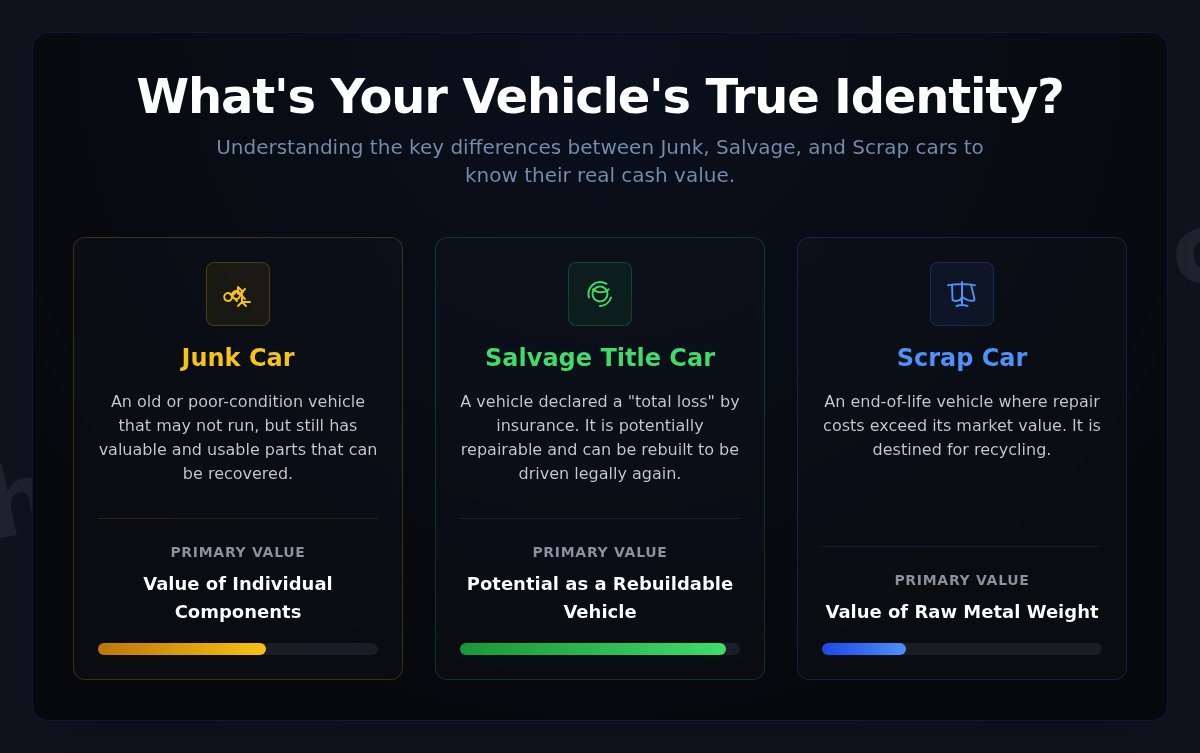
A junk car is a vehicle that is old, in poor condition, and no longer in regular use. It may or may not run. The key distinction is that it might still have valuable, usable parts that can be removed and sold individually. Think of it as a car that’s on its way to becoming scrap but hasn’t been officially designated for metal recycling yet. It has more potential value than just its weight in steel.
What is a Salvage Title Car?
A salvage title is a legal brand issued by an insurance company after a vehicle has been declared a “total loss.” This usually happens after a major accident, flood, or theft. Unlike a scrap car that is beyond repair, a salvage title car can potentially be rebuilt, pass a state inspection, and be legally driven again. Its value lies in its potential for restoration, not just its parts or metal.
| Vehicle Type | Key Characteristic | Primary Value |
|---|---|---|
| Junk Car | Old, non-running, but has usable parts. | Value of individual components. |
| Salvage Title Car | Declared a “total loss” but is potentially repairable. | Value as a rebuildable vehicle. |
| Scrap Car | End-of-life vehicle; not repairable. | Value of its raw metal weight. |
Why the Difference Matters For You
Your car’s classification directly impacts how much cash you can get for it. A salvage title car might be sold to a rebuilder for a higher price. A junk car is attractive to yards that pull and sell used parts. A scrap car’s value is based almost entirely on the current market price for recycled steel and other metals.
Knowing what you have ensures you are talking to the right buyer and getting a fair offer. We buy vehicles in any condition-scrap, junk, or salvage-and give you a top-dollar price based on its actual value. Stop wondering and find out what your car is worth now.
Not sure what you have? Get a fast, free quote today!
The Lifecycle of a Scrap Car: What Happens After You Sell It?
You got cash for your junk car, and we towed it away for free. So, where does your old car go? Many people worry that their vehicle will just sit and rust in a landfill. That’s not what happens. Selling your junk car is a responsible, environmentally friendly decision. The process is fast, efficient, and designed to recycle as much of the vehicle as possible.
The journey from a driveway problem to a source of raw materials is a structured, multi-step process. Here’s exactly what happens to your scrap car after you sell it.
Step 1: Depollution and Draining
The first and most critical step is making the vehicle safe to handle. Before anything else, all hazardous materials are carefully drained and removed. This includes gasoline, engine oil, coolant, transmission fluid, and brake fluid. The battery is also taken out for separate recycling. This depollution stage ensures that harmful chemicals never contaminate the soil or water.
Step 2: Dismantling and Parts Recovery
Next, the car is stripped of all valuable and reusable parts. A surprising number of components can be salvaged, cleaned, and resold. Once a vehicle is designated for this process, often matching the official legal definition of a scrap vehicle, every valuable component is recovered. This maximizes the vehicle’s value, which helps us pay you more cash. Parts we often recover include:
- Engines and transmissions
- Alternators and starters
- Tires and wheels in good condition
- Seats, dashboards, and stereos
- Body panels like doors and bumpers
Step 3: Shredding and Metal Separation
After all usable parts are removed, the empty metal shell of the car is all that remains. This hulk is fed into a massive industrial shredder, which tears it into small, fist-sized pieces of metal in minutes. The shredded material then moves along a conveyor belt where powerful magnets and advanced sensors separate the different types of metal. Ferrous metals (like steel and iron) are pulled out by magnets, while other systems separate aluminum, copper, and other non-ferrous materials.
These sorted metals are then bundled and sold as raw materials to steel mills and foundries. Your old car is now ready to be transformed into new products, completing its recycling lifecycle.
Common Scenarios That Turn a Car Into Scrap
Wondering if your vehicle is officially a scrap car? Definitions are helpful, but real-world situations make the picture clear. Many car owners hold onto a vehicle far too long, hoping for a miracle repair. If your car fits one of the descriptions below, it has reached the end of its life on the road. The next logical step is to sell it for cash.
Major Accident Damage
A serious collision is the fastest way for a car to become junk. When the damage is severe, repairs are often impossible or financially foolish. Your vehicle is a prime candidate for scrapping if the insurance company has already declared it a total loss. This usually happens when:
- The frame or chassis is bent, compromising structural safety.
- Airbags have deployed, leading to expensive system-wide replacements.
- Multiple body panels are crushed, crumpled, or destroyed.
In this state, the vehicle is unsafe and not worth fixing. Selling it for scrap is your best option.
Terminal Mechanical Failure
Sometimes, the damage isn’t from an impact but from a critical component failing inside. When the heart of the car-the engine or transmission-dies, you face an expensive choice. If a mechanic gives you a repair quote that costs more than the car’s market value, you have a certified junk vehicle. Common terminal failures include:
- A seized engine or a blown head gasket.
- A transmission that is completely shot and needs full replacement.
- Any repair bill that runs into thousands of dollars for an older, low-value vehicle.
Don’t sink good money into a bad car. Get paid for it instead.
Advanced Age and Decay
Even without a major failure, time takes its toll. A car that’s over 15 or 20 years old often becomes a money pit. Rust, wear, and obsolete technology make it unreliable and unsafe. Your car is ready for the scrapyard if it is plagued by issues like:
- Severe rust and corrosion on the underbody, frame, or rocker panels.
- Essential parts are discontinued and impossible to find for repairs.
- It repeatedly fails state safety inspections or emissions tests.
Does this sound like your car? Stop letting it take up space and become an eyesore. That pile of metal is not worthless. Turn it into cash now!
Your Scrap Car Has Value: How to Get Paid For It
Now that you understand what makes a vehicle a scrap car, the next step is turning that liability into an asset. That car sitting in your driveway or garage isn’t worthless-it’s a source of instant cash. The value of any junk vehicle is primarily based on its weight, the current market price for scrap metals, and whether it’s complete with major components like the engine and transmission. While you could try to navigate this process yourself, the fastest and easiest way to get paid is by calling a professional service.
Why Selling to a Service is Your Best Option
Selling your car for scrap doesn’t have to be a complicated project. Using a dedicated service like Cash For Junk Cars Michigan eliminates all the common headaches and gets you paid fast.
- Avoid the DIY Hassle: Parting out a car yourself takes time, specialized tools, and a place to store components. We buy the entire vehicle, saving you the work.
- Skip the Scrapyard Run: You don’t need to find a local scrapyard or figure out how to pay for a tow truck. Our service handles all the logistics for you.
- Get a Guaranteed Offer: Forget haggling with scrapyard operators. We give you a firm, fair quote over the phone, and that’s the amount you get paid. No games, no last-minute changes.
The Process is Simple: Call, Get a Quote, Get Paid
We’ve made our process incredibly straightforward because we value your time. We remove all the typical barriers to selling your unwanted vehicle so you can get your cash and move on.
- No Prep Needed: Don’t worry about making repairs, cleaning it out, or even finding the keys. We buy cars in any condition, as-is.
- Instant, Free Quote: Call us and we’ll give you a top-dollar offer for your car in minutes. There’s no obligation.
- Free Towing Across Michigan: Our team comes to you, wherever you are, and tows your car away completely free of charge.
- Cash On The Spot: Our driver arrives with your payment. You get paid cash right then and there. No waiting for a check to clear.
Stop looking at that old car as a problem. It’s an opportunity. Ready to turn your unwanted scrap car into cash today? Get your free quote now and see how easy it is to sell your car for cash.
Turn Your Scrap Car into Fast Cash Today
Understanding what makes a vehicle a scrap car is the first step to unlocking its hidden value. As we’ve covered, a car reaches this stage when its repair costs exceed its worth, making its raw materials the primary source of its value. But the most important takeaway is simple: that car sitting in your driveway isn’t just a heap of metal. It’s an asset waiting to be converted into cash, quickly and without any hassle.
Why wait? At Cash For Junk Cars Michigan, we specialize in turning your problem vehicle into an immediate payment. We buy cars in ANY condition-wrecked, rusted, or non-running. Don’t have the title? No problem. We provide free towing anywhere in Michigan and, best of all, our driver pays you cash on the spot. No delays, no deductions, just fast cash for your car.
Stop letting that car take up space. It’s time to get paid. Get Your Instant Cash Offer and Free Towing Now!
Frequently Asked Questions About Selling Your Scrap Car
Can I scrap a car without a title in Michigan?
Yes, you can sell your car without a title in Michigan. We make the process simple. As long as you have a valid, state-issued photo ID and the vehicle’s registration in your name, we can buy your car. We handle the necessary paperwork to make the sale fast and legal. If your situation is different, call us. We are experts at solving title problems and getting you cash for your junk car today.
Do I get more money if my scrap car still runs?
Yes, you will always get a better cash offer if your car is running. A running vehicle has more valuable, salvageable parts like the engine and transmission. These components can be resold, which increases the car’s overall value to us. Even if it doesn’t run, we will still buy it. We always pay the best price based on your car’s complete condition. Call us now for an instant quote and see how much cash you can get.
How is the price of a scrap car actually calculated?
We calculate your cash offer based on a few key factors. The most important is the vehicle’s weight, as this determines its scrap metal value. We also consider the year, make, and model of your car. The condition and presence of valuable parts, like the catalytic converter, engine, and transmission, will also increase your payout. We check current market rates for steel to guarantee you get the best, most accurate price for your scrap car.
What do I need to do to prepare my car for scrapping?
Preparing your car is simple and fast. First, remove all your personal items from the glove box, trunk, and cabin. We are not responsible for anything left inside. Second, have your paperwork ready. This means having the title or your photo ID and registration on hand for our driver. That’s it. You do not need to clean the car or fix anything. We handle the free towing and all the heavy lifting for you.
Is it better to scrap a car or donate it to charity?
The best choice depends on your goal. Donating a car may offer a tax deduction, but the process can be slow and the final value uncertain. Scrapping your car with us puts cash in your hand today. It is the fastest, most direct way to get value from your unwanted vehicle. There is no paperwork hassle and no waiting. If you need immediate cash and a guaranteed payout, scrapping your car is the better option.
How quickly can you pick up my scrap car?
We are fast. In most cases, we offer same-day pickup. Once you accept our cash offer, we will schedule a pickup time that works for you, often within just a few hours. Our goal is to get your car removed and pay you cash as quickly as possible. We pride ourselves on fast, reliable service with free towing. Call us in the morning, and your unwanted car could be gone with cash in your hand by the afternoon.