

Spending weeks dismantling a rusted SUV might seem like a smart financial move, but the reality often leaves you with more grease on your hands than cash in your pocket. You want to maximize your return on that junk vehicle sitting in your driveway, so you’re likely asking is it better to part out a car or sell it whole? You probably feel that selling individual components like the catalytic converter or the transmission will bring in more money than a bulk sale. It’s a common belief that more work equals more profit, but that isn’t always the case in the Michigan used parts market.
Deciding how to handle your vehicle requires a hard look at your actual resources. This guide compares the profit margins, the 40 plus hours of labor required for stripping a vehicle, and the strict Michigan Secretary of State title requirements you must follow to avoid legal trouble. We’ll show you how to avoid environmental fines for improper fluid disposal and how to get that car off your property today. You will learn exactly when to grab your tools and when to just call for a free tow and an immediate cash payment.
Key Takeaways
- Understand the financial reality of gross revenue versus net profit to decide is it better to part out a car or sell it whole.
- Identify the hidden costs of DIY stripping, from professional-grade tool requirements to the legal risks of storing vehicle shells on Michigan property.
- Navigate Michigan Secretary of State regulations and avoid heavy fines by learning the mandatory “Scrap Title” requirements for dismantled cars.
- Use our simple 3-question test to determine if your vehicle is worth the time-intensive part-out process or if same-day cash is the smarter move.
- Secure an immediate cash offer today and save up to $300 in transport fees with free towing provided across Michigan.
Parting Out vs. Selling Whole: The Financial Reality Check
You want the most cash for your junk car. Most Michigan owners ask the same question: is it better to part out a car or sell it whole? On paper, parting out looks like a gold mine. You see an engine listed for $900 and a transmission for $600. You think you’ll double your money. This is usually a mistake. Gross revenue is not the same as net profit. You must buy specialized tools. You pay for shipping. You pay listing fees. By 2026, the Michigan used parts market is flooded with inventory. Buyers want parts immediately. They won’t wait for you to pull a starter in a freezing driveway in January. Selling the car whole is the only way to guarantee a specific payout today.
Every day a half-stripped car sits in your yard, it becomes a “Dead Asset.” In Michigan, moisture and road salt residue cause rapid oxidation on exposed frames. A car missing its doors or hood loses its scrap value fast as the interior ruins. You also face the risk of fluids leaking into the soil, which can lead to expensive environmental cleanups or city fines. Selling whole stops the bleeding and puts cash in your pocket before the asset hits zero value.
The Part-Out Profit Myth
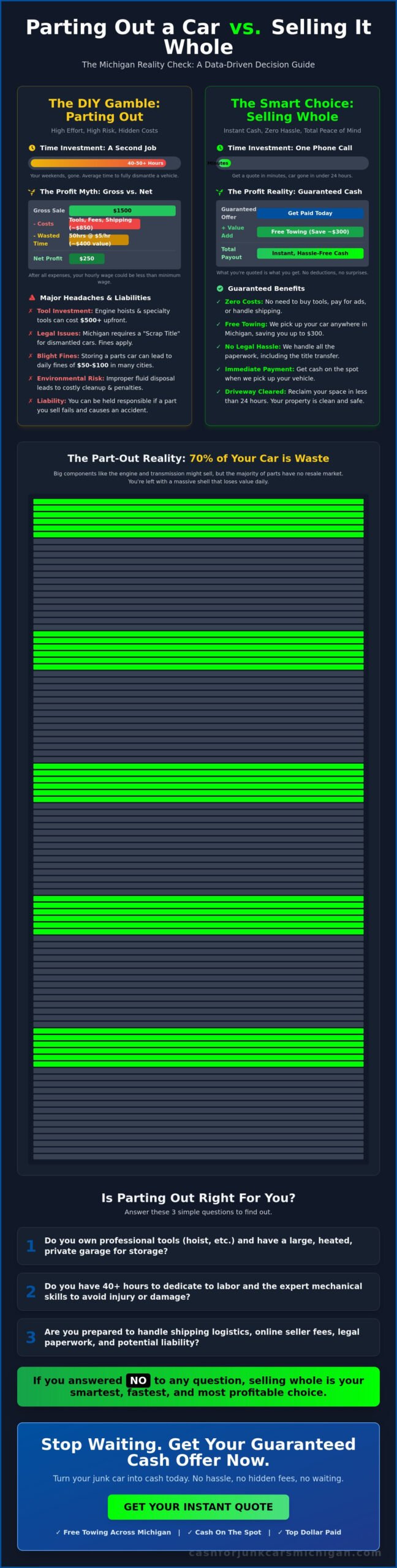
Big components sell first. Engines, transmissions, and catalytic converters move quickly if they work. After those are gone, you are left with a massive steel shell. Statistics show that 70% of a vehicle’s components, including plastics, wiring harnesses, and interior trim, end up as waste because they have no resale demand. Professional facilities understand the vehicle recycling process and have the heavy machinery to process what’s left. You likely don’t. Online platforms like eBay now take 13% or more in total fees. When you factor in the cost of heavy-duty shipping crates, your “profit” disappears into logistics and paperwork.
Selling Whole: The Speed Premium
Deciding on selling a car for parts is choosing to take on a second job. It takes between 30 and 50 hours of labor to fully dismantle a modern vehicle. If you make an extra $250 but spend 50 hours working, you earned $5 per hour. That’s a bad investment of your time. When you ask yourself is it better to part out a car or sell it whole, consider the value of your Saturday mornings. Selling the car whole gives you cash on the spot. We provide a free tow. Your driveway is clear in less than 24 hours. You get immediate liquidity without the months of waiting for a stranger on Marketplace to show up.
The Hidden Costs of the DIY Part-Out Strategy
Many owners wonder is it better to part out a car or sell it whole when they see high prices for used alternators or engines online. The reality is that parting out a vehicle requires a massive investment in time and equipment. You can’t pull an engine with a basic $20 socket set. A reliable engine hoist costs between $200 and $400, while a set of heavy-duty jack stands and a floor jack will add another $150 to your bill. If you don’t already own these tools, your profit margin disappears before you remove the first bolt.
Storage is another major hurdle for Michigan residents. Keeping a dismantled “parts car” in your driveway often violates local municipal codes. In cities like Grand Rapids or Detroit, blight violations can result in fines ranging from $50 to $100 per day. Michigan winters also complicate things. Road salt and moisture cause exposed components to rust quickly, destroying the value of the parts you’re trying to sell. If you don’t have a heated, oversized garage, you’re fighting a losing battle against the elements.
Shipping logistics often turn into a nightmare. A transmission weighs roughly 150 to 250 pounds. Shipping an item that heavy requires palletizing and freight services, which can cost $200 or more depending on the destination. You also face significant liability risks. If you sell a used steering rack or brake component that fails and causes an accident, you could be held legally responsible for damages. Selling the entire vehicle to a professional buyer avoids these legal and financial traps.
Mechanical Expertise and Equipment
Taking a car apart is dangerous work. Professional teardowns require specialized tools like impact wrenches, torches for rusted Michigan bolts, and fluid extraction systems. Amateur mechanics often break brittle plastic sensors or strip aluminum threads during removal, turning a $200 part into scrap metal. You also face personal safety hazards. Pressurized AC systems and heavy coil springs can cause serious injury if handled incorrectly. If you want to avoid the physical risk, it’s faster to get cash for junk cars and let the experts handle the recycling.
The Buyer Management Headache
Selling parts piece-by-piece means dealing with the public constantly. Data from online marketplaces shows that up to 40% of buyers are “no-shows” who waste your time. You’ll deal with lowball offers and people asking if a 2005 Ford part fits a 2012 Chevy. There is also a security risk. Inviting strangers from social media to your home to look at parts isn’t ideal. Managing returns for “parts that don’t work” adds another layer of stress to an already slow process.
Michigan Legal and Environmental Requirements
Michigan law treats a vehicle as a legal liability until the title is properly transferred or canceled. The Michigan Secretary of State (SOS) has strict rules for anyone dismantling a vehicle. You can’t simply pull the engine and leave the rest on the curb. If you choose to dismantle a car, you are technically a “vehicle scrap metal processor” in the eyes of the state. Most owners don’t realize they need a “Scrap Title” to legally dispose of the frame once the valuable parts are gone. When you weigh whether is it better to part out a car or sell it whole, you have to account for the time spent at the SOS office and the risk of local fines.
Title and Paperwork Hurdles
Selling a car piece by piece creates a massive paper trail that most people aren’t ready to manage. Every major component you sell carries a risk if the vehicle title remains in your name. Selling junk cars to a licensed buyer is a much safer route. It ensures the title is closed out correctly and the state knows you no longer own the vehicle. Many people fall into the trap of “title jumping” by selling parts and then giving the shell to a friend without a legal transfer. This is illegal in Michigan. We buy cars with no keys, no registration, or no title to help you avoid these legal traps. We handle the paperwork so you don’t have to worry about the Secretary of State.
Eco-Friendly Disposal of the Remaining Shell
The Michigan Department of Environment, Great Lakes, and Energy (EGLE) monitors how automotive fluids are handled. You can’t just let motor oil, transmission fluid, or toxic coolant leak into the Michigan groundwater. Professional facilities use specialized drainage systems to catch these hazards. If you part out a car in your driveway, you are responsible for every drop that hits the pavement. Potential fines for environmental violations can cost more than the parts you sold.
Most scrapyards in Michigan won’t even accept a “picked over” shell. They make their profit on the heavy components like engines and catalytic converters. If you strip those out, you might be stuck with a 2,000-pound hunk of steel that no one will tow away for free. In cities like Detroit and Grand Rapids, city ordinances are very strict about “nuisance vehicles.” Detroit City Code Section 8-4-1 allows the city to tow and impound cars that are disassembled or missing major parts. Grand Rapids inspectors also issue tickets for inoperable vehicles sitting in plain sight. It’s often better to sell the whole car for cash today rather than fighting city hall over a shell in your yard.
When Selling Whole is the Smarter Choice
Deciding if is it better to part out a car or sell it whole usually depends on your available time and tools. Most Michigan vehicle owners find that selling the car as a complete unit is the most efficient path. Ask yourself these three questions before you pick up a wrench. First, do you have a professional garage space to store a dismantled shell for six months? Second, do you have 50 or more hours of free time to manage buyers? Third, do you have the equipment to safely remove heavy components like engines? If you answered no to any of these, selling the whole car is your best move.
Immediate cash beats possible future profit for the average seller. Parting out a car is a gamble. You might sell the alternator today, but the transmission could sit on your shelf for a year. When you sell the whole vehicle, you get a single, guaranteed payment. Cash For Junk Cars Michigan provides same-day cash and handles the logistics. We even buy cars with no keys, no registration or no title. This eliminates the stress of finding individual buyers for every door handle and sensor.
Free towing significantly impacts your net payout. If you part out a car, you eventually have to pay someone to haul away the heavy steel frame. This cost can eat up $100 to $200 of your profit. We provide FREE towing for every vehicle we buy. This ensures you keep every dollar of your quote. To maximize your offer, keep the car intact. A complete car with its original catalytic converter and battery always commands a higher price than a picked-over shell.
The Decision Matrix: Time vs. Money
Use this simple three-step process to see if parting out is worth the effort. Step 1: Get a quote for the whole car from us first to establish your baseline. Step 2: Research the “sold” prices of the top 5 most valuable parts on eBay, such as the engine, transmission, and infotainment system. Step 3: Subtract 40% from that total to account for platform fees, shipping costs, and the eventual disposal of the shell. If the remaining number isn’t significantly higher than our cash offer, sell it whole and save your weekends.
Avoiding the Sunk Cost Fallacy
Many owners hold onto a project car because they think it will eventually be worth more in pieces. In reality, these vehicles often become permanent lawn ornaments that collect rust and fines from the city. Recognizing when a project has failed is the first step toward a clean driveway. There is a massive psychological relief that comes with immediate payment and a clear workspace. Current data shows that scrap car prices are peaking in 2026, making this the ideal time to liquidate your vehicle. Don’t let your car lose value while it sits.
Get Fast Cash with Cash For Junk Cars Michigan
Deciding is it better to part out a car or sell it whole usually comes down to how much time you want to waste. Parting out a vehicle requires months of storage, constant messages from strangers, and dozens of trips to the post office. Cash For Junk Cars Michigan eliminates that stress immediately. We buy cars in any condition, whether they are fully intact, missing parts, or completely wrecked from a collision.
Our “No-Hassle” promise means we take the vehicle as it sits. You don’t need to scrub the interior or fix the engine. We provide free towing across the entire state of Michigan. While local towing companies often charge between $150 and $300 for a single haul, we cover that cost entirely. This ensures the offer you receive is the actual cash you keep. We also specialize in difficult situations that stop other buyers. If you have no title or no keys, we handle the paperwork and logistics for you. Our goal is to move you from a phone call to cash in hand in under 24 hours.
Why We Are Michigan’s Trusted Junk Car Buyer
We built our reputation on a direct, transactional approach that respects your time. You won’t find hidden fees or last-minute price drops when our driver arrives. We understand that a junk car is a problem you want solved quickly, so we provide a reliable, no-nonsense service that residents count on. We are committed to paying the best price for junk vehicles in Detroit and all surrounding Michigan cities to ensure you get the maximum value for your asset without the headache of a private sale.
- Reliability: We show up when we say we will.
- Transparency: The quote you get over the phone is the cash you get at the curb.
- Efficiency: We value speed because we know you have better things to do.
How to Get Your Instant Quote Today
When you are weighing the options of is it better to part out a car or sell it whole, remember that our 3-step process is designed for maximum speed. You don’t have to wait for a buyer to need a specific alternator or door panel. You can sell the entire unit right now. To get started, have your vehicle information ready, including the year, make, model, and a brief description of the current condition. Once you provide those details, we give you a firm offer.
Our simple process works like this:
- Call: Reach out to our team for a quick consultation.
- Quote: Receive your instant cash offer based on current market rates.
- Cash: Schedule your free pickup and get paid on the spot.
Stop letting that old vehicle take up space in your driveway or garage. Whether it’s a rusted truck, a flooded sedan, or a van that won’t start, we want it today. Get an instant cash offer for your junk car now!
Turn Your Junk Car Into Instant Cash
Deciding is it better to part out a car or sell it whole depends on your schedule and mechanical expertise. Most Michigan vehicle owners find that a DIY part-out requires 40 to 60 hours of labor and months of storage space. You also have to follow Michigan Department of Environment, Great Lakes, and Energy (EGLE) standards for hazardous fluid disposal. Most people simply don’t have the specialized tools or the patience for that level of work. Selling the entire vehicle is the fastest way to clear your driveway and get paid today.
We make the process simple by handling every detail for you. We buy cars in any condition, even if you have no title, no keys, and no registration. You won’t have to deal with expensive hidden fees or wait weeks for a private buyer to call you back. Our team provides same-day cash payments and includes free towing with every purchase we make. It’s the most reliable way to turn your problem vehicle into immediate profit without the mechanical headache.
Sell your car for cash today; we’ll tow it for FREE!
Take the easy route and put money in your pocket before the sun goes down.
Frequently Asked Questions
Is it legal to part out a car in my driveway in Michigan?
Legality depends on your local municipal zoning laws. In Detroit, City Code Section 9-1-36 prohibits residents from keeping dismantled or inoperable vehicles on private property for more than 15 days. Violating these ordinances can result in fines starting at $100 per day. It is often faster and safer to sell the whole car for cash today rather than risking a legal citation from your city.
How much more money can I make by parting out a car?
You can potentially earn 20% to 30% more than the scrap value, but only if you have high-demand components like a working engine or transmission. When deciding is it better to part out a car or sell it whole, consider the cost of your time. Most sellers spend 40 or more hours wrenching and listing parts. Selling the whole vehicle provides immediate cash without the months of labor.
Will a junkyard buy a car that has already had parts removed?
Yes, we buy cars in any condition, even if they are missing major components. However, removing parts like the catalytic converter or the battery will reduce your final payout. A missing catalytic converter can lower the scrap value by $100 to $400 depending on the precious metal content. We provide free towing regardless of whether the car is complete or a stripped shell.
What are the hardest parts to sell when parting out a car?
Heavy structural items and interior plastics are the most difficult to move. Shipping a 100-pound door or a bulky dashboard is expensive, which limits your buyers to local people only. Statistics show that roughly 60% of a car’s weight consists of low-demand steel and trim that most buyers don’t want. You often end up stuck with a heavy frame that is difficult to discard.
Do I need a special license to sell car parts in Michigan?
You don’t need a license to sell parts from one personal vehicle you own. However, Michigan Compiled Law 257.248 requires a used vehicle parts dealer license if you buy and sell parts as a business. If you plan to flip parts from multiple cars, the state requires you to maintain a Class C license. We are a fully licensed service that buys your car legally and quickly.
How do I dispose of the leftover car frame after parting it out?
You must pay a towing service to haul the leftover frame to a licensed scrap processor. In Michigan, scrap yards will not accept a vehicle frame without the original title to prevent the sale of stolen metal. Expect to pay a local towing fee of $75 to $150 to move the shell. We eliminate this cost by picking up the entire car and providing free towing from your location.
Can I sell my junk car if I don’t have the title or registration?
We buy junk cars even if you have no keys, no registration, or no title. While parting out a car without paperwork is hard because you can’t easily scrap the frame later, we handle all the documentation for you. This is the fastest way to get cash for your vehicle without the headache of filing for a duplicate title at the Secretary of State.
How long does it typically take to sell all the parts from a vehicle?
It typically takes 6 to 12 months to sell the majority of a car’s parts on online marketplaces. You’ll spend dozens of hours answering messages, dealing with “no-show” buyers, and cleaning greasy components. If you want to avoid the long wait, selling the whole car is the best choice. We can usually complete the entire transaction and put cash in your hand within 24 hours.