

What if the hardest part of selling an old car isn’t deciding what it’s worth, but agreeing on what it means to your family? A family discussion about selling an old car can bring up practical concerns, memories, and different ideas about what should happen next. One person may want to keep it, while another is thinking about repair costs, paperwork, or the space it takes up.
You can work toward a clear answer without rushing anyone. Compare the car’s condition and ongoing responsibilities with each person’s needs, then consider keeping, selling, donating, or recycling it. If your family chooses to sell, a buyer that includes free towing can simplify removal, especially for a damaged or non-running vehicle.
This guide explains how to start the discussion respectfully, gather useful facts, and work through disagreements. You’ll also learn how to clarify ownership and paperwork, compare options, and agree on a practical next step. The goal isn’t to make everyone feel the same way about the car. It’s to make a decision together that fits your family.
Key Takeaways
- Start the family discussion about selling an old car by making room for different feelings and focusing on a shared decision, not persuasion.
- Write down what you know about the car’s condition, use, ownership, and ongoing responsibilities before comparing options.
- Weigh keeping, selling, donating, or recycling the car against your family’s needs, the effort involved, and what happens next.
- Use a simple conversation plan to hear concerns, review facts, and work through disagreement without blame.
- If your family agrees to sell, assign clear tasks for paperwork, belongings, value research, and removal. Cash For Junk Cars Michigan includes free towing for vehicles it buys.
Start the Family Discussion About Selling an Old Car Without Rushing
A family discussion about selling an old car can bring up more than questions about its condition or value. The car might hold memories of road trips, mark a child’s first years of driving, or represent independence for someone who still relies on it. Make room for those feelings alongside practical concerns, such as whether anyone uses the vehicle and who handles its upkeep.
Set the purpose before weighing options: the goal is a shared decision, not getting one person to give in. A productive discussion starts by understanding why each person wants to keep or sell the car. That shift lets everyone explain their reasons without having to defend their feelings.
Choose a respectful time and a clear goal
Choose a calm time when the people who use, own, or help maintain the car can take part. Avoid raising the subject during an argument, an urgent repair, or another stressful family event. Start with a neutral question: “Should we keep the car, sell it, or consider another way to let it go?” Make clear that the first conversation is for listening and gathering perspectives, not making an immediate decision.
Acknowledge memories without letting them decide everything
Ask each person what the car means to them before discussing its value or needs. Someone may treasure the memories without wanting to keep the vehicle indefinitely. Photos or a small keepsake can preserve a connection, but offer these as options, not as a way to pressure anyone toward selling. Recognizing both practical needs and personal attachment can make it easier to explore conflict resolution methods and keep the conversation respectful.
Listen for the need underneath each position. “I want to keep it” might mean the person depends on it, hopes to use it again, or isn’t ready to part with the memories. “We should sell it” might reflect concern about its condition or the work of keeping it. Ask follow-up questions without challenging the answer: “What would need to be true for keeping it to work?” or “What part of letting it go feels hardest?”
You don’t need to settle everything in one sitting. If emotions rise, pause and agree on a time to return to the topic. A patient opening helps family members feel heard before the group turns to the car’s condition, ownership, use, and responsibilities.
Lay Out the Old Car’s Condition, Use, Ownership, and Costs
Once everyone has shared their perspective, put the known facts in one place. Keep this step neutral. The purpose isn’t to prove that keeping or selling is right; it’s to make sure the family is discussing the same vehicle and circumstances. Agree on the car’s condition, use, and ownership facts before comparing options.
Use a simple shared fact sheet
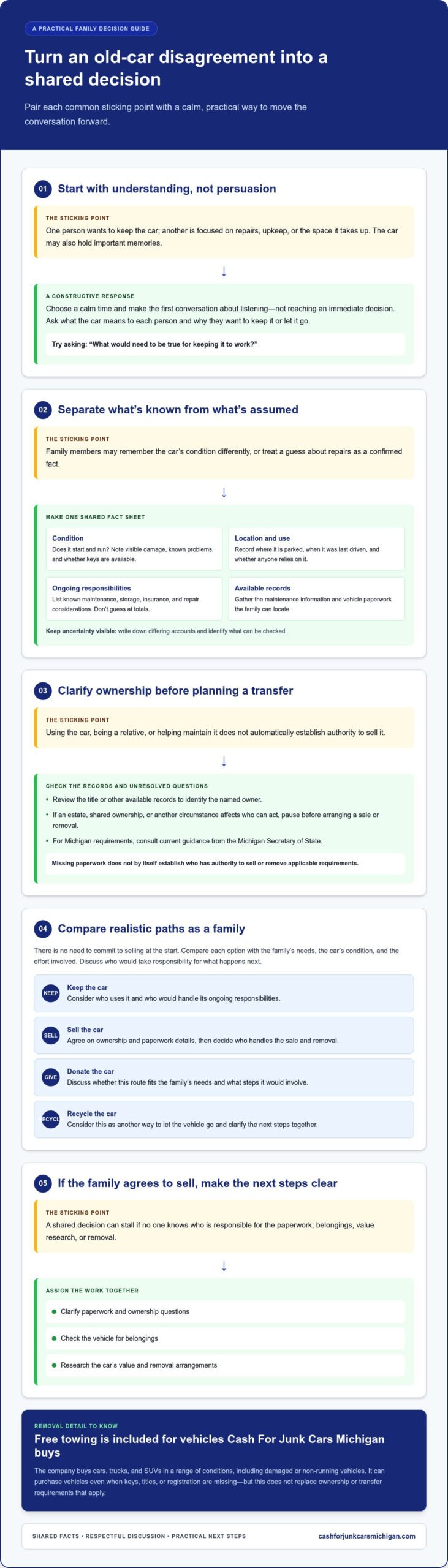
Write down what family members know, and mark anything uncertain as something to verify. Separate observations from assumptions. For example, “the car hasn’t been driven since last winter” is different from “it probably needs major repairs.” This keeps guesses from being treated as confirmed facts.
- Condition: Does it start and run? Note visible damage, known problems, and whether keys are available.
- Location and use: Where is it parked, when was it last driven, and does anyone rely on it for transportation?
- Ongoing responsibilities: List known maintenance, storage, insurance, and repair considerations. Avoid guessing at totals.
- Available records: Gather maintenance information and vehicle paperwork the family can locate.
If family members remember the car’s condition differently, record both accounts and identify what can be checked. A shared fact sheet makes the family discussion about selling an old car more practical, especially when some people use the vehicle and others mainly see the upkeep or space it occupies.
Clarify ownership and Michigan paperwork carefully
Review the title or other available records to identify the named owner. Don’t assume that being a relative, using the car, or helping maintain it automatically gives someone authority to sell. If an estate, shared ownership, or another circumstance affects who can act, pause before making plans to transfer the vehicle.
For Michigan requirements, consult current guidance from the Michigan Secretary of State before arranging a sale or ownership transfer. Missing paperwork doesn’t by itself establish who has authority to sell or remove applicable requirements. Separate what the family knows from what still needs clarification.
When your family is ready to let the car go, Cash For Junk Cars Michigan buys cars, trucks, and SUVs in a range of conditions, including damaged or non-running vehicles. The company includes free towing for every vehicle it buys and can purchase vehicles even when keys, titles, or registration are missing. That doesn’t replace any ownership or transfer requirements that apply. Review junk car buying and removal as one possible next step once the family has agreed to sell.
Compare Keeping, Selling, Donating, or Recycling the Car as a Family
The first conversation doesn’t have to commit your family to selling. Use it to compare realistic choices against your needs, the car’s condition, and the effort each option involves. Instead of assuming one choice is best, discuss what each path would require and who would take responsibility for it.
| Option | Family needs and vehicle condition | Effort, timing, and likely next step |
|---|---|---|
| Keep | May fit if someone has a clear, realistic use for the car and will take responsibility for it. | Agree on who will use and maintain it, where it will be kept, and when the family will revisit the choice. |
| Sell privately | May suit a vehicle that can be presented to potential buyers and a family ready to handle the sale process. | Research comparable vehicles, prepare the car and paperwork, and coordinate inquiries and the transfer. |
| Donate | May align with the family’s charitable priorities. The vehicle’s condition and the organization’s process affect what happens next. | Choose a charity, understand its donation process, and arrange the vehicle handoff. |
| Recycle or sell as a junk vehicle | May be practical for a damaged or non-running car the family has decided to let go. | Compare removal logistics and clarify paperwork before arranging the vehicle’s removal. |
When keeping the car still makes sense
Keeping it can be reasonable if someone can name a specific use, take responsibility for its care, and account for where it will be stored. “We might need it someday” isn’t the same as a workable plan. If the family keeps it temporarily, decide who handles its upkeep and set a date to review whether the plan is working.
When letting the car go may fit better
A private sale may involve preparing the car and coordinating with potential buyers. Donation follows a charity’s process, while recycling focuses on handling a vehicle that’s no longer useful. For a damaged or non-running car, include removal in the comparison. Cash For Junk Cars Michigan buys vehicles in a range of conditions and includes free towing for vehicles it buys. For factors that affect value, consult “Scrap Car Prices: How Much Is Your Junk Car Worth in Michigan?”
A family discussion about selling an old car can end with a short-term plan, not a final sale. If people aren’t ready to decide, agree on what information to gather and when to talk again. A specific review date helps prevent temporary storage from becoming an open-ended decision.
Use a Simple Conversation Plan to Work Through Disagreement
When family members disagree, slow the decision down and give each concern a place in the conversation. A clear process helps separate what people feel from what they need to know, and keeps the discussion from becoming a contest over who is right.
- Invite views. Ask each person what they think should happen and why.
- Summarize concerns. Reflect back what you heard before offering a response.
- Review the facts. Look at the vehicle’s use, condition, ownership, and known responsibilities together.
- Compare options. Consider keeping, selling, donating, or recycling in light of everyone’s needs.
- Agree on a next step. Choose a decision, or identify what information would help the family decide later.
Try conversation prompts that invite honest answers
Use questions that make room for both attachment and practical concerns: “What would you miss most if the car were gone?” and “What worries you about keeping it?” Then ask, “What would help a decision feel fair and manageable?” Before proposing an option, reflect the answer: “It sounds like you’re concerned about losing access to transportation.” This shows you’ve listened without implying that you agree on the final choice.
Handle disagreement without forcing a decision
Separate the issues instead of trying to settle them all at once. Emotional attachment, transportation needs, ownership questions, and vehicle condition may require different conversations or information. If a decision feels premature, agree on one small task, such as checking who is listed as owner or asking the person who uses the car to describe their transportation needs. Set a time to revisit the choice so the pause doesn’t become indefinite.
Keep the language focused on shared needs. Try, “What would make keeping the car workable?” instead of “You never use it,” or “What do we still need to learn?” rather than “You’re holding this up.” If ownership or authority to sell is disputed, pause sale plans and review relevant Michigan Secretary of State guidance before proceeding.
A family discussion about selling an old car can end with agreement on a next step, even if the family isn’t ready to choose an outcome. Once everyone agrees that selling is the right path, see how selling an unwanted car can work in Michigan.
Agree on Next Steps If Your Family Decides to Sell the Old Car
Once the family agrees to sell, turn that decision into a short written plan. Assign each task to one person and choose a check-in date. This prevents everyone from assuming someone else is handling the details and gives the family a clear way to track progress.
Make the agreed plan easy to follow
Write down who will handle each part, what needs to happen, and when you’ll review progress. Keep the list practical:
- Paperwork: Gather available vehicle documents and check current Michigan Secretary of State ownership-transfer guidance before completing a sale.
- Belongings and access: Remove personal items and note which keys are available.
- Valuation: Have one person research the car’s value using its actual condition and relevant comparisons.
- Coordination: Choose who will communicate with the buyer and organize the handoff or removal.
Be specific about the vehicle’s condition, whether it runs, its location, and any missing keys or documents. Clear details help the family plan realistically. If paperwork is missing or ownership is unclear, resolve those questions before proceeding. A missing document doesn’t automatically remove applicable ownership or transfer requirements.
Choose a practical route for a damaged or unwanted car
Match the removal plan to the car’s condition and your family’s preferred timing. A vehicle that runs may allow for different arrangements than one that’s damaged or won’t start. Cash For Junk Cars Michigan buys cars, trucks, and SUVs in a range of conditions, including damaged and non-running vehicles. Free towing is included for vehicles the company buys, and the company aims for same-day pickup throughout Michigan.
For a closer look at the steps involved, read “How to Sell My Junk Car for Cash: The Complete 2026 Guide.” Use it to help prepare for the sale, while keeping the family’s agreed plan and applicable paperwork requirements in view.
A family discussion about selling an old car is most useful when it ends with shared responsibilities, not just a verbal decision. Confirm who is coordinating, what still needs to be done, and how the family will stay updated. When you’re ready to move forward, get started with Cash For Junk Cars Michigan.
Move Forward With a Clear Family Plan
A calm family discussion about selling an old car starts with listening, then moves to shared facts. Review who uses the vehicle, its condition, ownership, and ongoing responsibilities before weighing whether to keep, sell, donate, or recycle it. If opinions differ, agree on what information is missing and when you’ll revisit the decision. You don’t need to settle every detail in one conversation.
If your family decides to sell, make the next steps clear: assign someone to gather paperwork, remove personal belongings, research value, and coordinate removal. Cash For Junk Cars Michigan buys unwanted cars, trucks, and SUVs in varied conditions, including damaged or non-running vehicles. Free towing is included for vehicles it buys, and the company aims to offer same-day pickup throughout Michigan.
With a shared decision and a simple plan, your family can move forward without letting uncertainty or disagreement take over. Get started with Cash For Junk Cars Michigan.
Frequently Asked Questions
How do I bring up selling an old car with my family?
Choose a calm time and explain that you want to make a shared decision, not pressure anyone to agree. Ask who uses the car, what it means to each person, and what concerns they have about keeping or selling it. You might say, “Can we talk through the car’s condition and our options before deciding what to do?” If emotions rise, pause and continue later.
What if one family member wants to keep the car and another wants to sell it?
Hear each person’s reasons before comparing options. One relative may rely on the car, while another is concerned about upkeep or storage. Summarize each concern without blame, then identify what information could help, such as whether anyone has a realistic plan to use and care for it. If the family still can’t decide, agree on a specific next step and a date to revisit the question.
Should we sell a car that no one in the family drives?
If nobody drives it, consider whether anyone has a concrete plan to start using it and take responsibility for it. Review its condition, storage, and ongoing responsibilities alongside other options, including selling, donating, or recycling. A family discussion about selling an old car doesn’t commit anyone to an immediate sale. It helps clarify whether keeping the vehicle serves a real need or simply postpones a decision.
How can we decide whether an old car is worth keeping?
Keep it only if there’s a clear use and someone willing to handle its care. Review when it was last driven, whether it runs, known damage, and any maintenance, storage, insurance, or repair considerations. Separate confirmed facts from guesses. Then agree on who will use and look after the vehicle, and set a date to reassess if the family decides to keep it temporarily.
Can a family sell a car if the title or keys are missing?
Cash For Junk Cars Michigan buys vehicles even when keys, titles, or registration are missing. First identify who has authority to sell and review applicable ownership-transfer requirements. Missing paperwork doesn’t remove legal or ownership requirements. For a Michigan vehicle, consult current Michigan Secretary of State guidance and resolve any ownership questions before arranging a sale.
What should we do before selling a family car?
Agree on the sale and assign someone to coordinate the process. Gather available vehicle paperwork, check current Michigan Secretary of State transfer guidance, remove personal belongings, and note the car’s condition, location, and available keys. Decide who will research its value and handle buyer communication or removal planning. If ownership is unclear, address that before proceeding with the sale.
How do we handle memories attached to an old family car?
Ask each person what they’ll miss or remember about the car before discussing its practical value. Acknowledge those feelings without assuming they require keeping the vehicle indefinitely. The family might take photos or keep a small memento, if that feels right to everyone. Offer these as options, not as pressure to sell. Separating memories from the decision about the physical car can make it easier to consider next steps.